
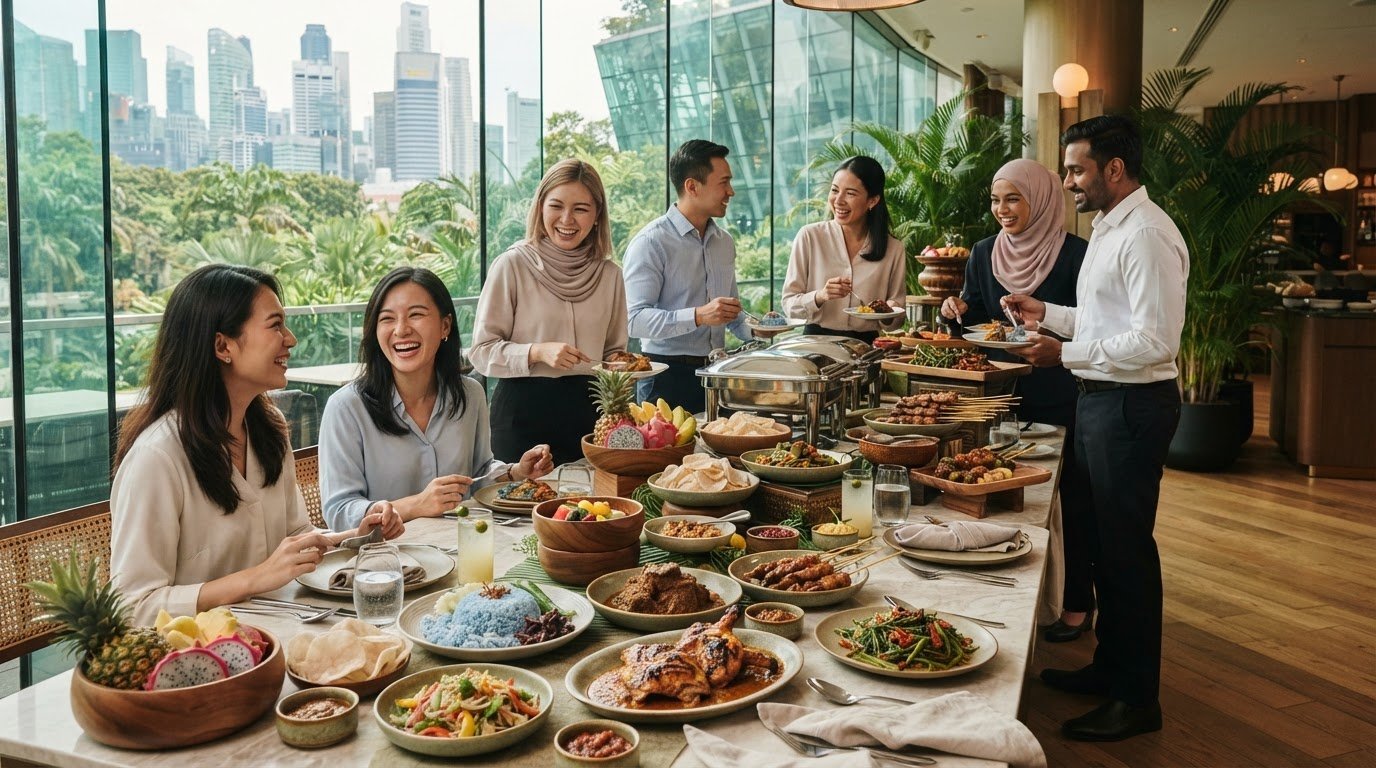

The best halal corporate lunch isn’t always a restaurant booking. A halal restaurant for corporate lunch can give colleagues a dedicated place to share a meal, while catering may suit a workplace gathering where staying on site is more practical. Choose the format by weighing the occasion, the lunch window and how the group wants to spend the time together.
Start with the purpose of the meal, then consider the menu, setting and service style. A sit-down restaurant meal, halal buffet and halal mini buffet each create a different experience and call for different planning. Regale offers restaurant dining and halal catering, with Western and local favourites during the day and authentic Indonesian dining in the evening.
This buying guide compares restaurant dining, catering, buffet and mini buffet formats, then covers practical steps for planning around headcount, dietary needs and schedule. It also explains how Regale’s halal-certified restaurant and catering options can fit different corporate lunch plans.
Key Takeaways
- Match the lunch format to its purpose, setting and schedule, whether colleagues dine together at a restaurant or eat at the workplace.
- Use a clear planning brief to coordinate an internal owner, estimated headcount, date, timing, meal setting and dietary information.
- When choosing a halal restaurant for corporate lunch, consider whether the menu and dining experience will suit the group.
- Compare restaurant dining, halal catering, buffet and mini buffet by setting, service style and the kind of group interaction each supports.
- Regale offers restaurant dining alongside halal catering, halal buffet and halal mini buffet options for corporate meal planning.
Choosing a Halal Restaurant for Corporate Lunch: Start with the Occasion
Start by identifying why the team is meeting. A working lunch has different demands from a client meeting or team celebration. The purpose helps you decide whether restaurant dining or a catered meal is a better fit before comparing menus and service formats.
A halal corporate lunch is a workplace meal planned around halal dining requirements and the needs of the group. For background on the broader meaning of halal, see Halal dietary laws and principles. For the organiser, the practical goal is to choose a setting and meal style that make colleagues feel included and fit the occasion.
A suitable corporate lunch meets the group’s halal dining needs while supporting the gathering’s purpose, schedule and comfort. Use this as the standard for comparing options, rather than choosing by menu appeal alone.
Match the lunch to its purpose
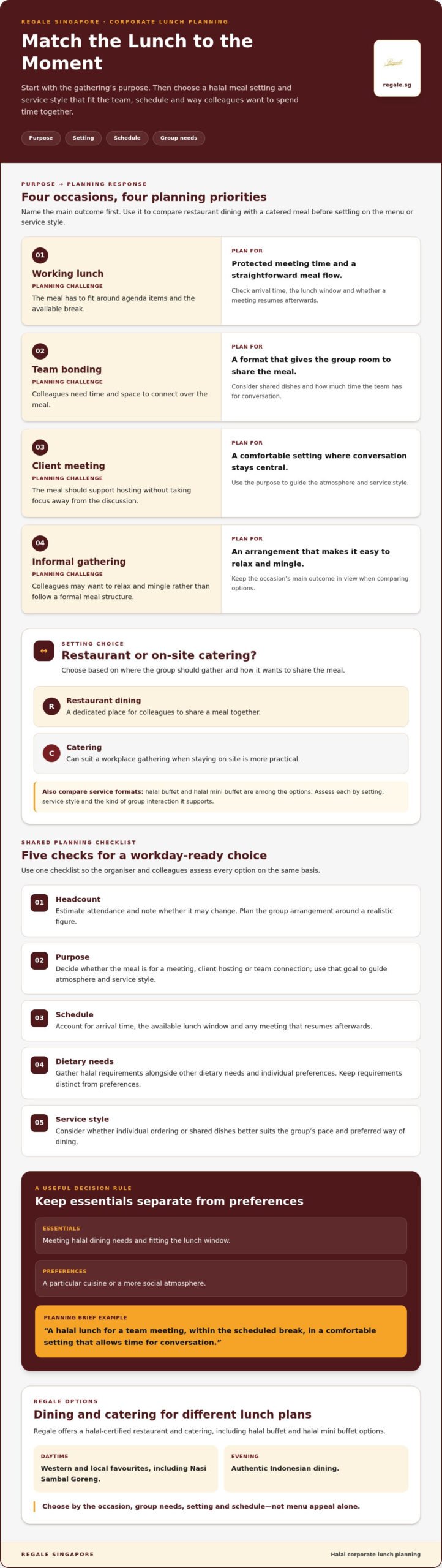
Identify the main outcome before choosing a format. A working lunch needs to fit around agenda items, so timing and a straightforward meal flow matter. A team celebration may benefit from shared dishes and time to talk. For client hosting, a comfortable setting that allows conversation to remain central may be a priority.
Use the purpose to guide the shortlist:
- Working lunch: Protect meeting time and choose a meal arrangement that fits the break.
- Team bonding: Look for a format that gives colleagues time and space to share the meal.
- Client meeting: Prioritise a comfortable setting where conversation can remain central.
- Informal gathering: Choose an arrangement that makes it easy for colleagues to relax and mingle.
These priorities are guides, not rigid rules. A client lunch may also be a team gathering, and a working lunch can still feel welcoming. Name the leading outcome first. That gives the group a consistent way to compare options when preferences differ.
Set a clear definition of success
Assess each option against four practical measures: halal suitability, timing, group comfort and ease of coordination. Separate essentials, such as meeting halal dining needs and fitting the lunch window, from preferences such as a particular cuisine or a more social atmosphere. This makes it easier to see which options meet the brief.
A concise planning brief could read: “A halal lunch for a team meeting, within the scheduled break, in a comfortable setting that allows time for conversation.” The organiser can use it to compare restaurant dining with catering before settling on a menu or service style.
Record the occasion, the main outcome and any non-negotiable needs. Carry those criteria into the next planning step, then add details such as headcount and timing. A written brief keeps the choice focused when several formats appear suitable.
How to Evaluate a Halal Restaurant for Your Corporate Lunch
Once the purpose is clear, compare restaurants against the realities of the workday. The group’s size, dietary needs and schedule all affect whether a meal will feel comfortable and straightforward to organise. Use one shared checklist so the organiser and colleagues assess each option on the same basis.
A suitable work-lunch venue brings together halal assurance, a fitting menu, a comfortable dining experience and a schedule that works for the team. Use these checkpoints to make the comparison practical:
- Headcount: Estimate attendance and note whether it may change. This helps you plan the group arrangement around a realistic figure.
- Purpose: Decide whether the meal is for a meeting, client hosting or team connection, then use that goal to guide the atmosphere and service style.
- Schedule: Account for arrival time, the available lunch window and any meeting that resumes afterwards.
- Dietary needs: Gather halal requirements alongside other dietary needs and individual preferences.
- Service style: Consider whether ordering individually or sharing dishes better suits the group’s pace and preferred way of dining.
Assess menu fit and dietary inclusion
Collect dietary needs and preferences before narrowing the options. Halal suitability is a distinct requirement; preferences such as spice level, familiar flavours or a particular dish are separate considerations. Keeping them distinct helps organisers communicate clearly and avoid treating one colleague’s preference as a group-wide dietary rule.
A varied menu can give colleagues more choice, while familiar local dishes can make a shared meal appealing to a mixed team. Regale’s daytime offering includes Western and local favourites, including dishes such as Nasi Sambal Goreng. For information about halal certification in Singapore, see MUIS Halal Certification in Singapore and consider halal assurance as part of your selection criteria.
Check practical fit for the workday
Compare the meal with the team’s calendar. A meeting that starts soon after lunch calls for a different pace from a celebration with more time for conversation. Consider when colleagues will arrive, how they will be seated and whether the meal fits comfortably before the next commitment.
Convenience is not only about travel or speed. It also means having a plan that is easy to explain, a setting that suits the group and a meal that fits the working day. Use the actual headcount and available lunch window to guide your decision. Teams considering a halal restaurant for corporate lunch can explore Regale’s daytime Western and local dining, as well as its authentic Indonesian dining in the evening.
Restaurant Dining, Buffet, or Catering: Compare Corporate Lunch Formats
The right format depends on where colleagues will eat, how they will share the meal and how the organiser wants to coordinate it. Restaurant dining gives the group a dedicated place to meet. Catering brings the meal to a workplace or event setting, while buffet and mini buffet are distinct catering options to consider.
Choose the setting first, then compare the service style and group experience that best suit the team. This keeps the decision grounded in practical needs rather than menu appeal alone.
| Format | Setting | Organizer involvement | Group interaction | Work-schedule fit |
|---|---|---|---|---|
| Restaurant dining | A restaurant dining space | Coordinate the group’s attendance and meal timing | A shared setting supports conversation | Works when the group can travel and dine within the lunch window |
| Halal catering | Workplace or event setting | Plan the meal around the chosen setting and schedule | Colleagues can gather without leaving the event setting | Useful when keeping the meal at the workplace is a priority |
| Halal buffet | A buffet arrangement at the meal setting | Coordinate how the buffet fits the event and its timing | A shared meal can encourage colleagues to mingle | Consider it when the schedule allows a more flexible meal flow |
| Halal mini buffet | A mini buffet arrangement at the meal setting | Plan around the format and the group’s dining routine | Can provide a shared meal setting without requiring restaurant dining | Compare it with the lunch window and the level of service preferred |
When restaurant dining suits the occasion
Restaurant dining suits a group that wants to step away from the workplace and share a meal in a dedicated setting. It creates a clear destination for the group and can give colleagues room to talk, whether the lunch is for team connection or a professional meeting. The main consideration is whether travel and dining fit the available time.
When halal catering, buffet, or mini buffet fits better
Consider catering when the meal should take place at the workplace or another event setting. A buffet and a mini buffet are separate service categories, so compare them by the kind of meal experience and coordination style the team wants. Regale offers halal catering, halal buffet and halal mini buffet for corporate meal planning.
For a workday with fixed commitments, think through how colleagues will access the meal and return to their tasks. Restaurant dining may suit a team that values time together away from the workplace; a catered arrangement can keep the meal on site. Match the format to the schedule, setting and preferred meal service.
For teams considering a halal restaurant for corporate lunch, Regale brings restaurant dining and catered meal options together. The daytime menu features Western and local favourites, while authentic Indonesian dining is offered in the evening. This gives organisers options to consider as they decide where and how the group wants to dine.
Plan a Halal Corporate Lunch with a Simple Organizer’s Checklist
A clear plan helps the organiser coordinate the meal and share useful updates with colleagues. Keep one concise brief as the reference point, then use it to guide the format choice and communicate arrangements. Start with the purpose, internal owner, estimated headcount, date, meal setting, timing and dietary information.
- Define the purpose. State whether the lunch is for a meeting, team gathering or another workplace occasion. This gives the group a shared reason for the meal and helps guide later decisions.
- Name an internal owner. Assign one person to coordinate details, collect responses and share updates. Colleagues then know where to direct questions or dietary information.
- Estimate attendance. Record the expected headcount and note whether it is still being finalised. An estimate gives the organiser a basis for planning without presenting it as a confirmed number.
- Set the date and timing. Include the lunch date, available meal window and any meeting commitments that affect the schedule. Consider when colleagues are expected to arrive and when they need to return to work.
- Choose the meal setting and preferred format. Note whether the team plans to dine at a restaurant or have the meal in a workplace or event setting. Record whether restaurant dining, halal catering, buffet or mini buffet is the current preference.
- Gather dietary information and share the plan. Provide a clear way for attendees to communicate dietary needs through the company’s chosen process. Share the arrangements in one accessible message.
Prepare a useful lunch brief
Keep confirmed decisions separate from open preferences. The date and meeting schedule may be settled while the dining format is still under discussion. Label those points clearly so colleagues know what is decided and where their input is useful. A concise brief should include the purpose, estimated group size, preferred format, timing and dietary requirements.
Communicate arrangements to colleagues
Once the plan is settled, send a short update with the meal format, timing and location details. Include participation instructions, such as how to respond, the RSVP deadline and how to share dietary needs through the company’s chosen process. A clear message helps attendees prepare without making them search through separate updates for essential details.
After the lunch, collect concise feedback. Note whether the timing suited the team, whether the arrangements were clear and what could be improved next time. If a restaurant meal suits the brief, explore Regale’s halal dining options as part of your shortlist for a halal restaurant for corporate lunch.
Choose Regale for a Halal Corporate Lunch That Fits Your Team
Regale is a halal-certified culinary establishment in Singapore with restaurant dining and catering options for workplace meals. Organisers can plan a shared restaurant meal or consider halal catering, a halal buffet or a halal mini buffet. Start with the team’s brief, including the occasion, preferred setting and schedule.
Regale’s menu brings together different culinary traditions. The daytime menu features Western and local favourites, while the venue offers authentic Indonesian dining in the evening. Nasi Sambal Goreng, Nasi Ambeng, Nasi Minyak and Briyani are among its traditional specialties. These dishes reflect the restaurant’s range and culinary identity.
Match Regale’s dining and catering options to the brief
Restaurant dining can suit colleagues looking for a shared meal away from the workplace, with a dedicated setting for conversation. For a catered meal, Regale offers halal catering, halal buffet and halal mini buffet options. Consider which format best matches the setting, service style and group experience the organiser wants.
Let the setting guide the choice. If the group wants to meet at a restaurant, consider Regale’s daytime Western and local dining. If the meal is planned for a workplace or event setting, compare the catering, buffet and mini buffet options against the lunch purpose and schedule. This keeps planning focused on the team’s needs.
Explore a halal lunch with Regale
For an organiser seeking a halal restaurant for corporate lunch, Regale brings halal-certified restaurant dining together with catering formats. Its menu spans Western and local favourites by day and authentic Indonesian dining in the evening, with traditional specialties that reflect that breadth. Use the team’s purpose, schedule and preferred setting to choose a suitable way to bring colleagues together.
Decide whether restaurant dining or a catered format best suits the occasion, then explore the relevant offerings. Explore Regale’s halal dining and catering.
Make Your Next Team Lunch Easier to Plan
Turn your shortlist into a simple next step: share the lunch purpose, preferred setting and schedule with the colleagues involved in organising it. With those priorities clear, you can choose a format and communicate one coherent plan to the team. A suitable halal restaurant for corporate lunch should support both the practical details and the kind of gathering you want colleagues to have.
Regale brings restaurant dining and catered lunch options together, giving organisers different formats to consider as they shape their plans. Use your brief to decide which setting and service style best suit the occasion.
Explore Regale’s halal dining and catering and take the next step towards a welcoming, well-planned corporate lunch for your team.
Frequently Asked Questions
How much should a company budget for a halal corporate lunch?
Set a per-person spending limit based on the company’s budget, then estimate the total using the expected number of attendees. The overall cost depends on the chosen setting and meal format. Compare the full costs for the selected arrangement with the budget before finalising the plan.
Can a company plan a halal corporate lunch for colleagues with different food preferences?
Yes. Organisers can make the meal more inclusive by distinguishing halal requirements from personal preferences. Collect relevant dietary needs through a consistent internal process, then consider a menu with different food styles rather than assuming everyone wants the same dish. A mixed team may appreciate familiar local flavours alongside other menu categories, while spice preference remains an individual consideration.
What information should a company include in a corporate lunch invitation?
Include the reason for the gathering, date, start and end time, meal setting, participation instructions and RSVP deadline. If the lunch is off-site, provide the location details and arrival guidance. Tell attendees how to report dietary needs through the company’s chosen process, and name the internal contact for lunch-related questions. A concise invitation makes essential details easy to find.
How can a team assess whether its corporate lunch was successful?
Assess success against the purpose set for the gathering, not just whether the meal took place. For a working lunch, consider whether the schedule worked and the meeting objectives were met. For a team gathering, consider participation and opportunities for conversation. Afterward, ask attendees for brief feedback on the meal, clarity of arrangements and overall comfort, then record improvements for the next lunch.
What is Nasi Ambeng, and why might it suit a team meal?
Nasi Ambeng is an Indonesian rice meal associated with a spread of accompanying dishes arranged for sharing. Its communal style can suit a team gathering where colleagues want a shared dining experience and a taste of Indonesian culinary tradition. Regale features Nasi Ambeng among its menu specialties.
How can a company keep a corporate lunch within its budget?
Set a clear spending limit before choosing the format, use a realistic attendance estimate and avoid making plans around an uncertain headcount. Focus on essentials, such as the meal setting and dietary requirements, before adding optional elements. Compare the full cost of the selected arrangement and communicate the RSVP deadline clearly so the organiser can plan using the best attendance information available.
