
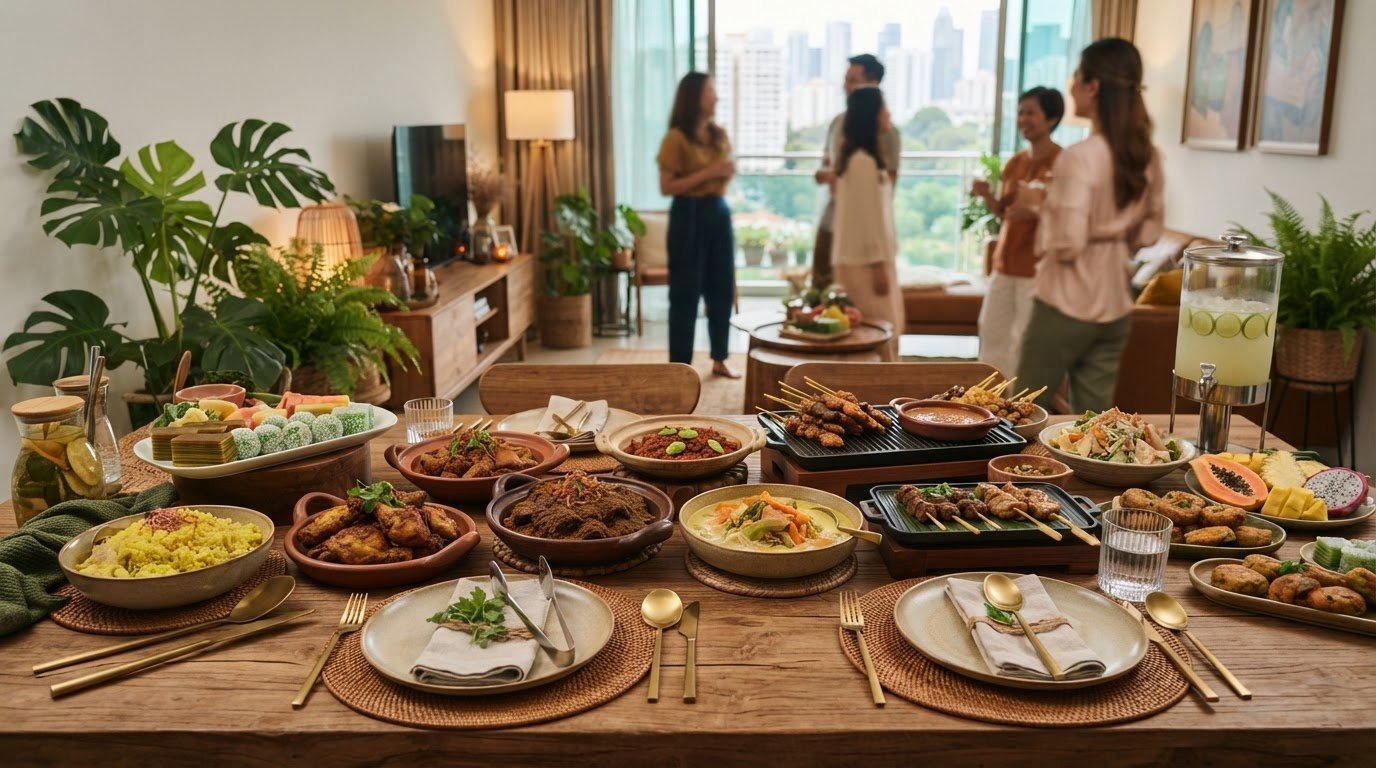

Children don’t need a separate party menu to find something they’ll enjoy. For a small gathering in Singapore, food catering for a small party at home can include a mini buffet for 15 or fewer, with familiar choices for younger guests alongside local favourites for adults.
It’s understandable to want food that suits the whole group without making hosting more complicated. A balanced menu can pair familiar favourites with distinctive local and Indonesian flavours, while keeping serving and cleanup practical for a home gathering.
This guide explains how to plan portions and menu choices for a small group, including kid-friendly options and ways to compare caterers. It also covers what can affect delivery fees, when self-collection may suit your plans, and how local favourites can bring character to the table.
Key Takeaways
- Match a mini buffet to your guest count, then choose a mix of familiar dishes and flavours that suit the gathering.
- Plan children’s portions around approachable options while giving adults room to enjoy more distinctive local favourites.
- Compare caterers by menu fit, serving arrangements and review details that reflect the kind of event you’re hosting.
- Account for delivery arrangements in your event plan, and consider self-collection when it suits your schedule and transport.
- Explore Indonesian and Western choices, including Nasi Sambal Goreng and Nasi Ambeng, for a table with local character.
Mini buffet catering for gatherings of 15 or fewer
For food catering for a small party at home, a mini buffet can suit a compact guest list and shared meal. Choose the format by guest count, dietary needs and available serving space.
Home Gathering Buffet Service
A mini buffet gives a small home gathering a shared table of dishes without requiring a formal dining arrangement. Count confirmed guests, then set aside space for trays, plates and serving utensils. A layout that works for 10 people may feel crowded with 15, especially in a compact dining area. Keep the serving route clear for children and adults.
A shared meal can work for a home celebration or an office gathering. Decide whether guests will serve themselves or need dishes placed near their seats. That choice affects the table layout and how much room to leave around the buffet.
Menus for Small Home Parties
The best catering options for a small Singapore home party are mini buffets with complementary mains, sides and familiar choices for children. Select food that is easy to portion, then balance mild flavours with dishes adults may prefer. Halal menus can suit guests seeking halal food. Vegetarian, vegan and allergy-aware choices depend on the dishes and ingredients available in each menu.
Which caterers offer halal, vegetarian, vegan, or allergy-friendly menus? Singapore caterers offer menus across these dietary categories, but the suitable choice depends on each menu’s dishes and ingredients. Compare the listed options with guests’ needs before choosing.
For food catering for a small party at home, dishes that share easily can make a practical buffet. Rice, mains and complementary sides give guests choices without requiring a separate plate for every dish. Keep children’s familiar options alongside more distinctive flavours, and label dishes so guests can identify what they are serving.
Home Catering Logistics
Book after settling the date, guest count and menu direction. Earlier planning leaves time to compare suitable formats, particularly when the gathering falls during a busy celebration period. Booking lead time depends on the date, menu and caterer’s order schedule, so make those decisions together rather than choosing dishes at the last moment.
Are there restrictions on catered parties in Singapore HDB flats or condos? Hosting arrangements can depend on estate or building management rules and shared-space considerations. Keep corridors and entrances clear, and plan the buffet inside the home.
How far in advance should you book home catering in Singapore? Book once your date, menu and guest count are settled, allowing time for the caterer’s order schedule and any dietary choices. A clear plan helps you compare options and organise the serving area before guests arrive.
Catering for small guest groups
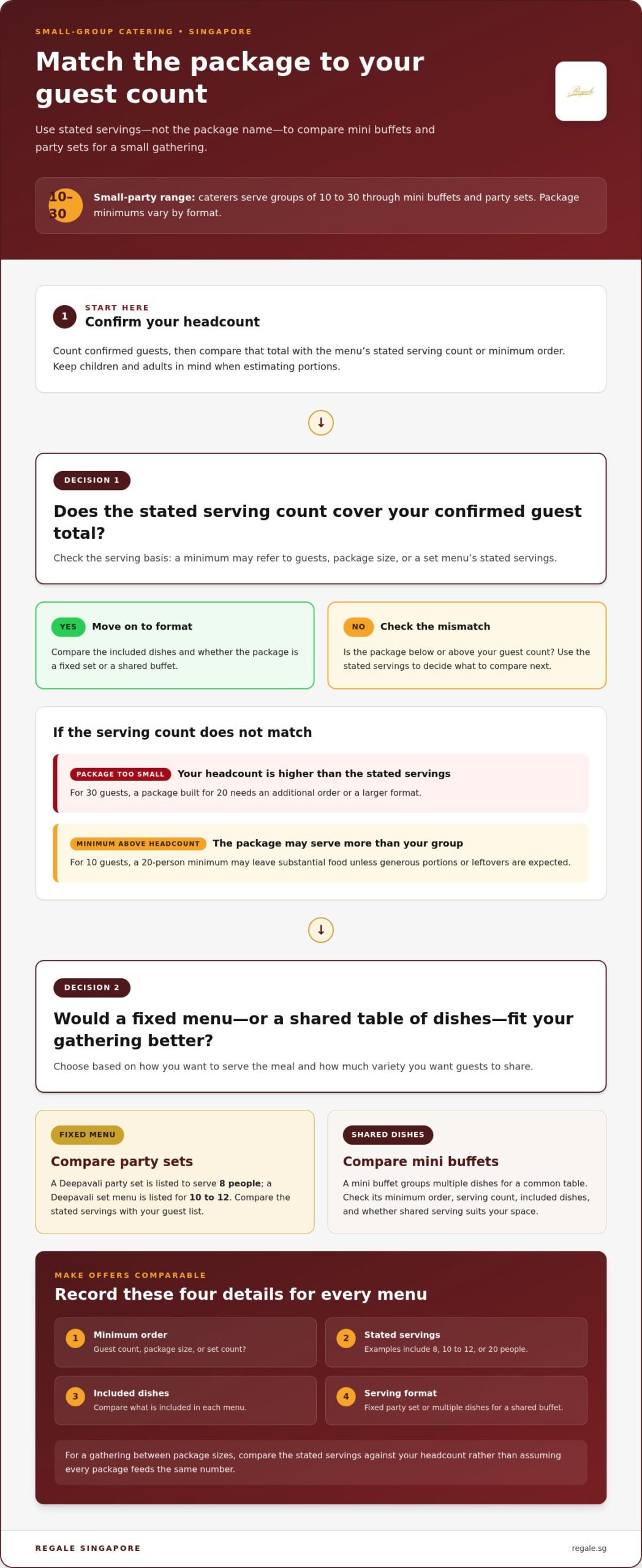
In Singapore, caterers serve small parties through mini buffets and party sets designed for groups of 10 to 30 guests. Compare each option’s minimum order, serving count and menu inclusions before choosing a format.
Small-Group Catering Minimums
A minimum order can be based on guest count, package size or a set menu’s stated servings. Match that threshold to your confirmed headcount rather than ordering by the number of households attending. For example, a buffet promotion and a mini buffet menu are each listed for 20 people. These examples show why checking the serving basis matters.
For a group of 10, a 20-person minimum may leave substantial food unless guests expect generous portions or leftovers. For 30 guests, a package built for 20 needs an additional order or a larger format. Compare the smallest available serving size with your actual guest total, then account for children and adults separately when estimating portions.
Ask what the minimum covers: the number of guests, dishes, or complete sets. A minimum expressed as a set count differs from one based on individual servings. Record the confirmed headcount, meal timing and preferred menu together, so each caterer’s offer can be compared on the same basis.
Party Sets for Small Groups
Party sets suit compact gatherings when a fixed menu is easier than selecting individual buffet dishes. A Deepavali party set is listed to serve 8 people, while a Deepavali set menu is listed for 10 to 12. Use those serving descriptions to compare set size with your guest list, rather than assuming every package feeds the same number.
For 10 guests, a set serving 10 to 12 may align closely with attendance. For 15 guests, compare whether the next package size or an additional set makes more sense. Check the dishes included and whether the format supports shared serving. A mini buffet offers a different structure, often grouping multiple dishes for a common table.
Which Singapore caterers offer mini buffets or small-party catering for 10 to 30 guests? Caterers with dedicated mini-buffet menus and party sets serve this range, with package minimums varying by format. Compare serving counts and menu inclusions to find an option that fits your guest total.
Use a simple comparison list for each menu: minimum order, stated servings, included dishes and format. For example, record whether a package is sized for 8, 10 to 12, or 20 people. This makes differences visible even when two menus use different serving structures.
For gatherings between package sizes, avoid estimating from the package name alone. Compare the stated servings against your headcount, then consider whether guests will share dishes or need individual portions. A set menu can simplify selection, while a buffet gives guests access to several dishes at the same table.
Customer reviews and caterer comparison
Customer reviews can help you judge how catering services perform beyond menu descriptions. Read comments for details about taste, delivery coordination, portioning and service, rather than relying only on broad praise such as “delicious.” A review describing a home birthday meal gives more useful context than one with no event details.
Compare providers against the same gathering scenario. For example, consider a family lunch with children, a compact dining area and guests arriving together. Check whether each menu suits that occasion, whether portions are described clearly, and whether delivery arrangements fit your plans. Matching the comparison criteria keeps the decision focused on practical needs.
- Menu fit: Look for comments naming dishes, flavour balance or menu variety.
- Portions: Note whether reviewers describe servings as suitable for their group.
- Arrival: Check for specific accounts of delivery timing and food presentation.
- Communication: Look for examples involving order updates or resolving a request.
- Dietary needs: Seek clear references to halal menus or stated ingredient needs.
Read both positive and critical feedback. A positive review that explains how a buffet suited a family gathering offers more evidence than a star rating alone. A critical review is most useful when it identifies the issue, such as an unclear menu description or a delivery delay. Look for recurring themes, not one isolated account.
Separate food quality from logistics. A reviewer may praise a delicious dish while describing a difficult setup, or report smooth service without discussing flavour. For a home party, both matter. Consider whether the feedback concerns the same format you plan to choose, since an individually served meal differs from a shared buffet.
Use a simple comparison note for each provider: chosen menu, serving details, delivery arrangement, dietary suitability and review evidence. For example, record whether reviewers discuss the same dishes you are considering. This makes it easier to compare actual experiences instead of choosing based on polished photographs or general claims.
Reviews reflect individual occasions, so give specific, relevant comments more weight than vague praise. Check whether the reviewer describes a similar event, menu format or guest mix. If several accounts independently mention the same strength or problem, treat that pattern as useful context, not a guarantee for your own gathering.
Finish by comparing the menu with the feedback. If reviews praise a particular dish, confirm it appears among the options you are considering. If guests have dietary requirements, prioritise clear menu descriptions over enthusiastic but general comments. This connects customer experience with the food you plan to serve.
Delivery fees and self-collection
For food catering for a small party at home, compare delivery with your event schedule and transport options. This is a promotion example, not a universal fee rule. Delivery charges and qualifying conditions can vary, so include the full delivery amount when comparing menus.
Before ordering, note your home address, preferred arrival time and access details. Delivery costs may depend on the delivery zone, order size, timing and site access. For example, a condominium drop-off may involve different entry arrangements from a landed home. Provide clear directions and relevant access instructions so the handover fits your function.
Self-collection can suit hosts with suitable transport and time to collect the food. Consider whether the containers fit securely in your vehicle and whether someone can collect while another person prepares the home. For a party in a flat, plan the route from vehicle to dining area. This helps you judge whether collection is practical alongside setup tasks.
Use this checklist to compare delivery and collection options:
- Total cost: Add any delivery charge to the food order, then compare it with collection travel costs.
- Timing: Match the delivery or collection window to your serving time and preparation schedule.
- Access: Note building entry steps, parking arrangements and the distance to your home.
- Transport: Check whether your vehicle can carry the packed order securely.
- Handover: Decide who will receive the food and where it will be placed.
For example, a host with convenient transport may prefer self-collection. Someone preparing the venue alone may find it easier to have food brought to the gathering, especially if carrying dishes would interrupt setup. Compare the time and effort involved, not just the stated arrangements. For food catering for a small party at home, that choice can shape how much preparation the host handles.
Promotional thresholds also affect the comparison. If your order is near that threshold, compare the final amount after the discount with the collection plan. Don’t add dishes solely to reach a promotion; choose a menu that fits your guests and meal.
Record the chosen arrangement in your event notes: delivery or collection, address or pickup point, arrival time, access instructions and the person receiving the food. Keep those details beside the menu and serving plan. For a home gathering, this helps coordinate the food’s arrival with table setup and guest arrival.
Oriental and local-favourite food options
A small-party menu can pair familiar local favourites with distinctive regional dishes. Choose a clear flavour direction, then add variety through sides and dessert rather than filling the table with unrelated mains.
For an Indonesian-inspired spread, nasi-based dishes can anchor the meal, with accompanying sides adding contrast. A menu built around rice gives guests a familiar base while introducing aromatic, savoury flavours. For a mixed group, balance richer dishes with lighter sides and a milder option. This approach works for a home birthday lunch or a corporate gathering where guests have different preferences.
Local favourites can also make a buffet feel rooted in Singapore. Consider familiar rice or noodle dishes alongside a regional speciality, then choose sides with contrasting textures. For example, a soft rice dish pairs well with crisp vegetables or a fresh salad. Keep the menu focused: a few well-matched dishes are easier to serve than several competing mains.
Use these steps to shape the menu:
- Choose a direction: Start with Indonesian flavours, local favourites, or a blend that suits the gathering.
- Select a base: Use rice or noodles to give the buffet a satisfying centre.
- Add contrast: Pair savoury mains with vegetable sides or a lighter dish.
- Finish thoughtfully: Include a dessert that complements the meal without crowding the serving table.
Dessert deserves a place in the plan, especially for a birthday or family celebration. A small, easy-to-portion sweet gives guests a clear finish after savoury dishes. For a corporate function, choose a format guests can serve without interrupting conversation. Keep dessert separate from hot dishes to protect presentation and make the buffet easier to navigate.
Consider how spice and richness affect the whole menu. If one main has bold seasoning, pair it with a milder side so guests can adjust each plate. Familiar flavours can sit beside more adventurous choices without creating a separate meal for children. Label dishes by name and note key ingredients clearly, helping guests choose with confidence.
A local-favourite menu also suits gatherings where food is part of the occasion. Indonesian dishes can bring distinctive regional character, while familiar Singapore-style options offer an accessible starting point. For a home celebration, arrange the buffet so rice, mains, sides and dessert follow a natural serving order. This reduces congestion and keeps the menu easy to understand.
A strong menu has a clear identity, practical serving flow and enough contrast for varied tastes. Select a central cuisine, add complementary sides, then finish with a suitable dessert. That structure gives a small gathering a memorable local character without making the table feel overfilled.
Regale Singapore: Nasi Sambal Goreng
Regale Singapore brings local and Indonesian character to a small gathering with Nasi Sambal Goreng, Nasi Ambeng and other Indonesian dishes. These options suit hosts looking for a distinctive centrepiece rather than a menu built only around familiar party staples. Western and local favourites are also part of Regale Singapore’s all-day dining menu.
Choose a direction based on your guests: Indonesian dishes can anchor a meal with regional character, while Western and local options offer other flavour profiles. This gives hosts a clear starting point when planning a home celebration around favourite dishes.
Explore Regale Singapore’s menu of Indonesian classics, local favourites and Western dishes when planning your gathering.
Shape a Gathering Around the Food
For food catering for a small party at home, let the menu reflect the atmosphere you want to create. A family meal can feel welcoming and distinctive when familiar and new flavours bring guests together around a shared table. Choose a culinary direction that suits your occasion, then let that choice guide the gathering’s tone.
Regale Singapore serves Nasi Sambal Goreng, Nasi Ambeng and authentic Indonesian cuisine. These choices give hosts a way to centre a celebration on Indonesian flavours. Consider them when you want food to play a meaningful part in the occasion, rather than simply fill the table.
Take the next step by choosing the experience you want guests to remember. Contact Regale Singapore to plan your party and explore a menu suited to your gathering. A considered food choice can help make your next celebration feel personal and welcoming.
Frequently Asked Questions
What does this caterer offer?
Regale Singapore serves Nasi Sambal Goreng, Nasi Ambeng, authentic Indonesian cuisine and Western cuisine. Its offerings also include Angus Burger, halal catering, halal buffet and halal mini buffet. For a home gathering, choose a cuisine direction first, then consider which dishes suit your guests’ preferences. This can help you decide whether an Indonesian-centred meal or a mix of Western and local favourites better fits the occasion.
What are the minimum order quantities and delivery fees for Singapore caterers?
Singapore catering menus use different order thresholds, including examples based on 10, 15 or 20 people. Set menus may instead describe servings, such as a set for 8 or 10 to 12 guests. Delivery fees depend on the order and delivery arrangement, so compare the final payable amount rather than the menu alone. A small order’s overall value can also depend on how closely the package matches your guest count.
What are the delivery, setup, and collection arrangements for home catering?
Delivery brings food to your stated address, while self-collection means arranging transport and carrying it home. For either option, plan who receives the order and where it will be placed. If the meal uses buffet trays, clear a stable serving surface beforehand. For collection, consider the journey, vehicle space and time needed to transfer dishes carefully into your home.
How can I compare caterer reviews, food quality, and cancellation policies?
Compare reviews that describe similar events and menu formats, and look for specific comments about taste, portions and presentation. Separate feedback on food from feedback about service or communication. Before ordering, read the cancellation terms and note any stated deadlines, charges or refund conditions. Keep the chosen menu and policy details together with your order record, so you can refer to the agreed terms if plans change.
Which Singapore caterers offer mini buffets or small-party catering for 10 to 30 guests?
Caterers with dedicated mini-buffet menus and party sets serve groups of 10 to 30 guests. Package minimums vary, so compare serving counts and menu inclusions.
