

A safe event menu starts with clear information, not guesswork. Managing dietary restrictions for events means collecting each guest’s needs, distinguishing allergies from preferences, and sharing the full list with the caterer at least two weeks before the event. Clear ingredient details and careful food handling help make those needs part of the plan from the outset.
Dietary requirements can reflect health, personal choice, culture, or religion, and each deserves respectful attention. Treating every request alike can leave guests unsure about what they can eat.
This guide explains why dietary needs matter and how to ask about them thoughtfully. You’ll learn to distinguish allergies from preferences, reduce cross-contamination risks, and plan for cultural and religious requirements, including halal meals.
With a thoughtful process, you can create a welcoming menu and give guests clearer information about the dishes served.
Key Takeaways
- Collect dietary needs clearly, follow up on specific requirements, and share the full guest list with the caterer at least two weeks before the event.
- Separate allergies, which can involve health risks, from preferences, and give guests clear dish labels and ingredient information.
- Reduce cross-contamination by separating ingredients and using clean, dedicated utensils and equipment for different dietary needs.
- Use registration questions to identify needs such as vegetarian, vegan, gluten-free, and nut-free meals, then plan suitable options.
- Respect cultural and religious requirements in both menu choices and preparation; according to Majlis Ugama Islam Singapura, halal meals must use equipment and facilities free from cross-mixing with non-halal substances.
1. Why cater for dietary requirements?
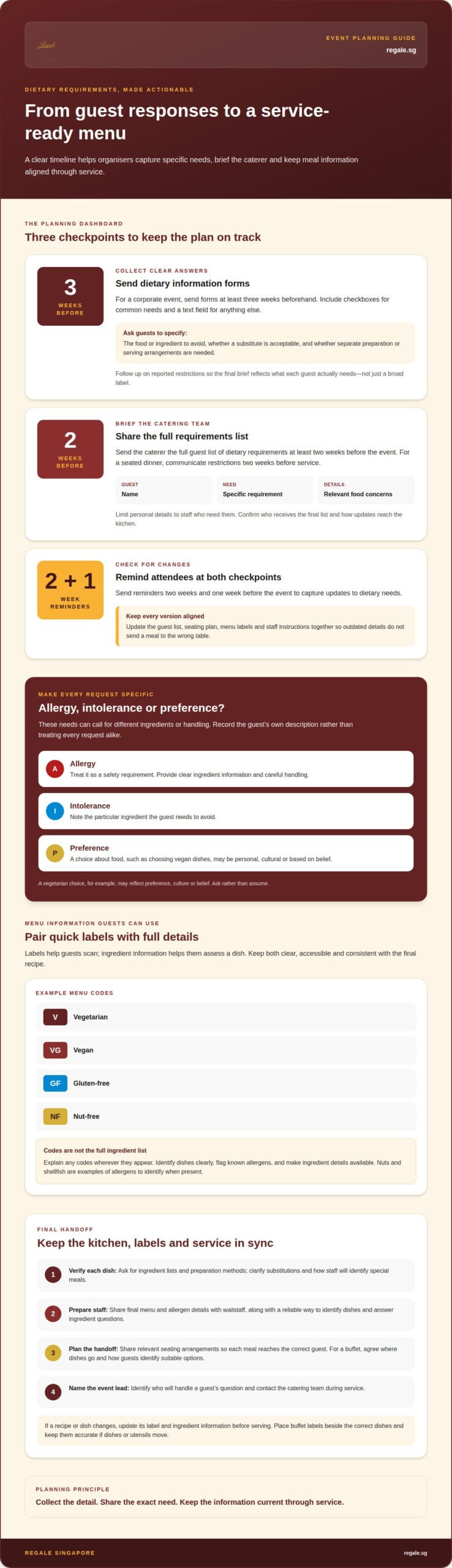
Dietary details shape menu choices, preparation, serving, and communication with guests. Managing dietary restrictions for events means turning each request into clear instructions for the catering and venue teams. For a corporate event, send dietary information forms at least three weeks beforehand. Include checkboxes for common needs and a text field for other requirements. Follow up with guests who identify a restriction, so the final brief describes what they need rather than relying on a broad label.
Ask guests to describe their requirement and any ingredients they need to avoid. An allergy, religious practice, and personal preference may call for different ingredients or handling. Share the full list of guests’ dietary requirements with the caterer at least two weeks before the event. For a seated dinner, communicate restrictions two weeks before service. Include the guest’s name, requirement, and relevant food concerns, while limiting details to staff who need them.
How many dietary-restriction meal options should planners order, and how much extra food is needed? Plan an option for each distinct reported requirement, and include alternative meals because some guests may not share their needs in advance. The amount depends on confirmed requirements and attendance, so avoid assuming one quantity will suit every event.
Ask the caterer for an ingredient list and preparation method for each dish. Clarify how substitutions affect recipes, how staff will identify meals, and how they’ll communicate dish contents. Share seating arrangements for guests with restrictions with waitstaff, so each meal reaches the correct person. Send menu options to attendees before the event, then use reminders two weeks and one week beforehand to capture changes.
When choosing a caterer, discuss operational details as well as the menu. Ask who receives the final dietary list, how updates reach the kitchen, and how staff identify special meals during service. Confirm that the venue layout supports clear labels and a reliable handoff between kitchen and waitstaff. For a buffet, agree where each dish will be placed and how guests can identify suitable options without guessing.
Managing dietary restrictions for events also means planning how staff will respond to concerns during service. Identify the event lead who will handle a guest’s question and contact the catering team. Keep the guest list, seating plan, menu labels, and instructions aligned; outdated details can send staff to the wrong table. This coordination turns dietary information into practical service and helps guests take part in the meal.
2. What’s the difference between food allergies and dietary preferences in event planning?
Treat an allergy as a safety requirement, while a preference guides a guest’s food choices. A guest avoiding peanuts because of an allergy needs clear ingredient information and careful handling. Someone choosing vegetarian dishes may avoid meat by preference, culture, or belief. Ask attendees to describe their needs plainly rather than assuming what a label such as “allergy” or “dietary” means.
Intolerances and preferences also need distinct notes. An intolerance may involve avoiding a particular ingredient, while a preference may concern the dish itself, such as choosing vegan food. The guest’s own description helps the organiser and caterer avoid treating all requests alike. Record the specific ingredient or food to avoid, whether a substitute is acceptable, and whether separate preparation or serving arrangements are needed.
For catered events in Singapore, use dish labels and make ingredient or allergen information available to attendees. This is a practical planning measure, not a statement about a particular statutory allergen list. Keep a complete ingredient list accessible and ensure labels match the final recipes. A dish label should identify the food clearly and flag known allergens, rather than relying on colour or an unexplained symbol alone.
Nuts and shellfish are examples of common food allergens to identify on menu cards when present. Share each dish’s ingredient details so guests can assess whether it suits their needs. If a recipe changes, update the label and ingredient information before serving. A sauce, garnish, or packaged ingredient can change what a dish contains, even when the main item stays the same.
Short codes can help guests scan a menu, but explain them wherever they appear. For example, “V” may indicate vegetarian, “VG” vegan, “GF” gluten-free, and “NF” nut-free. These labels describe a category, not every ingredient or preparation detail. Pair them with clear dish names and fuller information, especially when a guest has reported a specific allergy.
Share the final menu and allergen details with waitstaff before service. Give them a reliable way to identify each dish and respond when an attendee asks about ingredients. During buffet service, place labels beside the correct dishes and update them if dishes or serving utensils move. Clear, consistent information supports informed choices and helps guests understand what they are considering.
Dish labels and ingredient or allergen information work together: the label identifies the dish, while the details help attendees assess whether it suits them. Keep the information clear and accessible as guests consider their options.
This approach supports informed choices without requiring organisers to decide which foods suit each attendee.
3. Preventing cross-contamination
Cross-contamination occurs when an allergen transfers from one food, surface, utensil, or hand to another. Even a small transfer during preparation can make a dish unsuitable for a guest with an allergy. Treat each allergy instruction as a separate handling requirement. For example, a vegetarian dish may still contain an allergen through shared cooking oil, a knife, or a serving spoon. Keep preparation steps clear, from ingredient storage through service.
What food safety steps help prevent cross-contamination at events with food allergies? Clean and sanitise kitchen surfaces and equipment before preparing allergen-free dishes. Use separate utensils, cutting boards, and equipment; wash hands between handling different foods; and keep allergen-containing ingredients away from allergen-free items.
According to UK Government, food businesses should clean utensils before use, wash hands between preparing dishes with and without allergens, and store ingredients and prepared foods separately in closed, labelled containers. At an event, that means keeping containers sealed until needed and marking their contents clearly. Staff should avoid placing a clean utensil on a surface used for another dish. A fresh utensil is needed if the original one has touched an allergen.
Plan the kitchen sequence before cooking begins. Prepare allergy-sensitive dishes with clean equipment and surfaces, then protect them from contact with shared ingredients. Store finished dishes covered and apart from foods containing known allergens. During buffet service, place dishes containing allergens away from allergen-free options. Give each dish its own serving utensil, and replace it if it moves between trays.
Service procedures matter as much as kitchen preparation. Brief staff serving each meal on which dishes require special handling, where they are placed, and which utensils belong with them. Keep labels beside the correct dishes, and ask staff not to transfer utensils between trays. A clear handoff from kitchen to serving team reduces confusion when the room gets busy. It also helps staff respond calmly if a guest raises a concern or reports a reaction.
For halal meals, preparation requires attention to cross-mixing as well as allergens. According to Majlis Ugama Islam Singapura, halal meals must be prepared using equipment and facilities free from cross-mixing with non-halal substances. Reflect that separation in storage, cooking, and service arrangements. For every dietary need, assign responsibility for protecting the dish from preparation until it reaches the guest. This makes the process practical, not just a menu note.
4. Categories of dietary requirements at corporate events
Registration is a good place to collect dietary details in a consistent format. Ask attendees whether they have an allergy, intolerance, religious requirement, or food preference. Include a drop-down list for common needs and an open text field for anything else. This gives guests useful choices without forcing an unusual requirement into the wrong category. Invite a short explanation of ingredients to avoid or preparation needs.
How should event organisers ask about dietary restrictions and allergies during registration? Use clear, optional questions with checkboxes for common requirements and a text field for details. Follow up with attendees who report a restriction so the catering notes reflect their specific needs rather than a broad label.
Common categories include vegetarian, vegan, gluten-free, and nut-free. A vegetarian diet excludes meat, fish, and poultry; a vegan diet excludes animal products, including dairy and eggs. A gluten-free diet excludes wheat, barley, and rye, while a nut-free diet excludes nuts and nut products. These descriptions help with initial sorting, but attendees may need to clarify how a category applies to particular dishes or ingredients.
Some guests may report a specific allergy, such as shellfish, rather than a broad dietary category. Record the ingredient they need to avoid, and keep that information distinct from preferences such as choosing plant-based food. For example, “no shellfish due to allergy” communicates a different need from “prefers vegetarian meals.” This detail helps the menu team plan appropriate dishes and gives event staff a clear basis for answering questions.
Religious requirements need their own registration options. Halal food is permitted under Islamic law and excludes pork and its by-products. Kosher food is permitted under Jewish law, excludes pork and its by-products, and requires separate preparation areas for meat and dairy. These needs involve more than choosing a dish based on its main ingredient. Ask attendees to describe the requirement they follow, then pass that information to the catering team for menu planning.
Collect details early, then revisit them before finalising the menu. A corporate registration form can use separate fields for allergies, intolerances, religious needs, and preferences. Link each response to the attendee, not just to a total count for each category. If a guest writes “gluten” or “kosher” without further detail, follow up respectfully. Their explanation can clarify which choices work and what the event team should communicate to the caterer.
5. Accommodating religious and cultural dietary restrictions
Religious and cultural requirements can shape ingredients, preparation, and serving practices, not just a dish’s name. A menu marked “meat-free,” for example, may still not meet a guest’s religious needs. Ask attendees to describe the requirements they follow, then record their own terms accurately. Avoid assumptions based on a person’s name, appearance, or background. This gives the catering team practical information and helps guests feel heard.
For halal meals, both ingredient selection and handling matter. According to Majlis Ugama Islam Singapura, halal meals must be prepared using equipment and facilities free from cross-mixing with non-halal substances. Build this requirement into the preparation plan, storage arrangements, and service instructions. A suitable ingredient list alone does not address equipment or facility separation, so share the handling requirements with the kitchen and serving teams.
Kosher requirements also involve preparation arrangements, including separate areas for meat and dairy. A dish’s ingredients may therefore be only one part of whether it suits a guest. During planning, capture the guest’s stated requirement and communicate it clearly to the catering team. Don’t substitute a general label for the details the guest provides. A specific instruction helps staff serve the intended meal without relying on assumptions.
Cultural needs can also influence preferred dishes and meal customs. Offer varied choices where the menu allows, and invite attendees to explain any requirements that affect their meal. For example, a guest may need a particular ingredient excluded, while another may need distinct handling for religious reasons. Keep those notes separate in the event plan. This prevents a preference from being mistaken for an allergy, or a religious requirement from being reduced to a single ingredient.
Before service, align the final menu, preparation notes, dish labels, and staff briefing. Identify which meals need separate handling, where they will be stored, and how staff will distinguish them at the table or buffet. Keep the relevant utensils with each dish, and brief the person responsible for serving it. If a menu item changes, update its label and share the revised information with the team before service begins.
Good accommodation combines respectful questions with precise operations. Collect the guest’s own description, share it with the people preparing and serving food, and preserve the requirement through each handoff. For an event menu shaped around halal choices and varied dining preferences, plan a culturally considerate event menu with a clear brief for the catering team.
Regale Singapore
Regale Singapore serves Indonesian and Western cuisine for diners planning a shared meal. Its menu includes Nasi Sambal Goreng, Nasi Ambeng, and Western favourites, giving event organisers different styles to consider when shaping a gathering’s menu. These choices can complement a broader plan that accounts for guests’ stated dietary and cultural needs.
Use the planning steps above to communicate each requirement clearly and keep ingredient, preparation, and serving details aligned. Regale Singapore is a natural next step when you’re considering Indonesian or Western dishes for an event meal. Contact Regale Singapore to discuss your event dining plans.
Make your next event menu more inclusive
Thoughtful managing dietary restrictions for events starts with treating each guest’s needs as part of the event plan, not an afterthought. Use the details you’ve gathered to shape a menu and service approach that respects health needs, personal choices, and cultural practices. Clear communication gives the catering team a practical brief and helps guests make informed choices.
For an event featuring Indonesian cuisine, Regale Singapore serves dishes such as Nasi Sambal Goreng and Nasi Ambeng. Share the dietary requirements you’ve gathered when planning your event menu so they can be considered alongside the food choices. A well-planned meal can bring guests together while respecting the different needs at the table.
Contact Regale Singapore to plan your event. Take the next step with care, and create a gathering where every guest feels considered.
Frequently Asked Questions
Why cater for dietary requirements?
Catering for dietary requirements helps guests take part in a shared meal without having to guess what they can eat. It also gives organisers a practical way to account for health needs, personal choices, and religious or cultural practices. For example, a clearly identified alternative can help a guest with an allergy or a vegetarian guest choose confidently. Planning ahead also helps event staff give consistent information during service.
How do you collect dietary information from attendees effectively?
Use an event registration form that combines selectable options with space for individual details. Ask attendees to describe the ingredient or food they avoid, whether the need relates to an allergy, and any preparation concern that affects their meal. For example, a guest can distinguish a peanut allergy from a preference to avoid nuts. Review responses together before sending the final menu brief, and follow up when an answer is unclear.
What’s the difference between food allergies and dietary preferences in event planning?
A food allergy is a health-related restriction that can require specific ingredient and handling information; a preference describes what someone chooses to eat. For instance, an attendee may avoid shellfish because of an allergy, while another may choose vegetarian food. Record the distinction rather than grouping both requests under “special meal.” This helps the event team prioritise accurate ingredient details and understand which choices are based on personal preference.
How far in advance should event organizers collect dietary requirements?
For a corporate event, send dietary information forms at least three weeks before the event. This gives attendees time to respond and organisers time to clarify details. Send the full list of requirements to the caterer at least two weeks before the event, then use reminders two weeks and one week beforehand to catch changes. Keep the final version clearly dated so the venue team and catering staff work from the same information.
How should event catering label dishes and communicate ingredients and allergens?
Place a readable label beside each dish and make ingredient information available to guests. Identify known allergens such as nuts or shellfish, and keep the information aligned with the recipe actually served. If a garnish or sauce changes, update the label before service. Explain any abbreviations on the menu, since symbols alone may not tell attendees what a dish contains or whether it suits their specific requirement.
What Singapore food-allergen labelling and food safety rules apply to catered events?
For catered events in Singapore, label dishes clearly, flag known allergens, and make complete ingredient information available to guests. These are practical planning measures, not a specific statutory allergen list; clean, dedicated utensils and equipment can also help reduce cross-contamination.
