
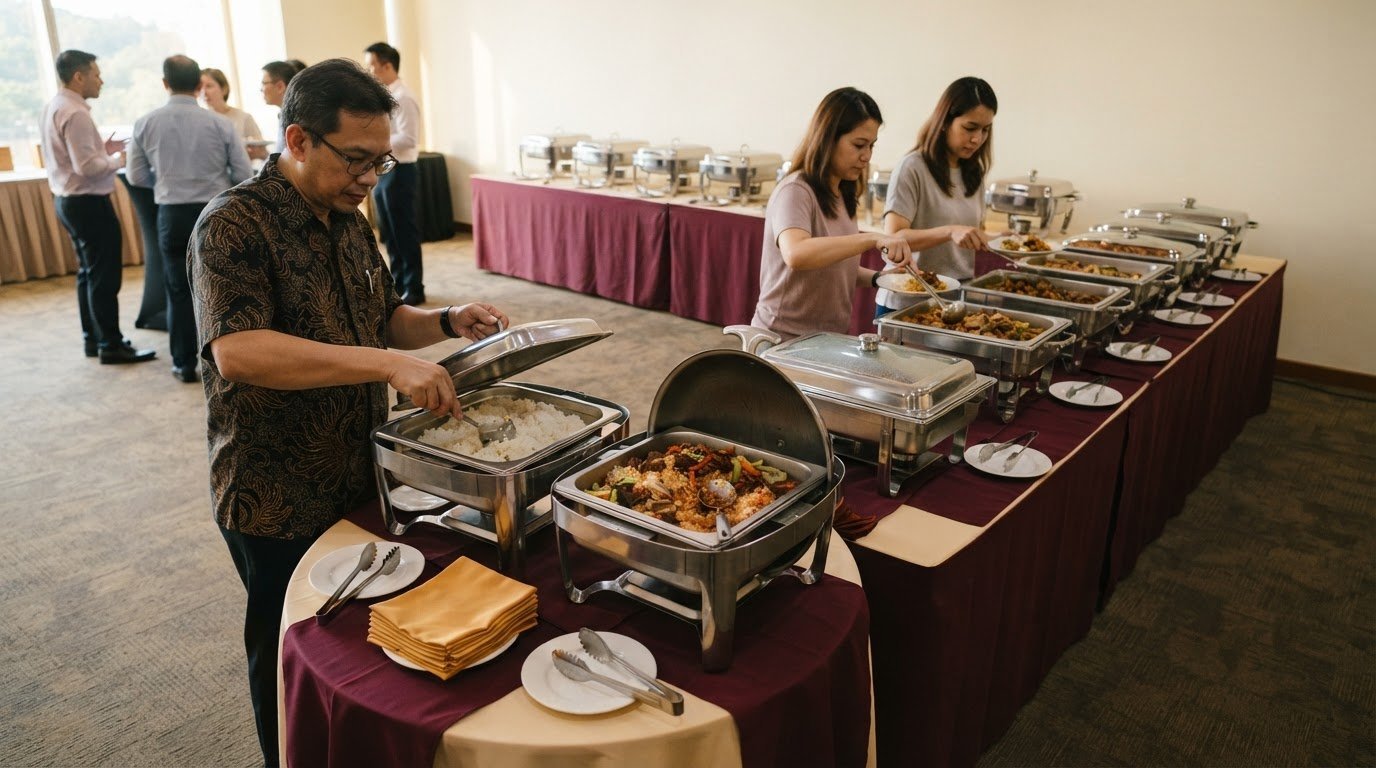

The choice between a mini buffet and a regular buffet in Singapore often comes down to guest count and the kind of spread you want to serve. A mini buffet generally suits gatherings of up to 50 guests, while a regular buffet is often a better fit for 50 or more. Mini buffet sets commonly serve 4-8 guests per set, while a set-up buffet typically offers 8-12 or more dishes.
Both formats make sharing a meal easier, but they differ in space, setup and hosting needs. A mini buffet can suit a smaller gathering or a compact serving area, while a regular buffet may work better for more guests and a venue with room for a serving line.
To choose between a mini buffet and a regular buffet, consider your guest count, menu, venue layout and how you want guests to serve themselves. These factors help you pick a practical format and plan the food and serving space.
Key Takeaways
- Choose your buffet format around the guest count, how the meal will be shared and the level of hosting support you need.
- For a compact venue, consider how much room guests need to serve themselves and move comfortably around the spread.
- Compare the menu’s variety and serving style with the event’s tone, from a casual gathering to a more formal occasion.
- Plan quantities around guests’ appetites and the event duration to make the shared meal practical and reduce unnecessary leftovers.
- Use the decision guide to match your guest list, venue and hosting preferences to the catering format that fits best.
Choosing a buffet by event size and hosting needs
In Singapore, a mini buffet is commonly suited to events with up to 50 guests, while regular buffet catering is often ideal for 50 or more. Smaller gatherings also have more specific planning ranges. Family dinners of 8-10 people can suit a mini buffet, while sets are often recommended for groups of 10 to 15 or 15 to 20. These figures are useful starting points, not substitutes for considering the event’s format and hosting demands.
Match the spread to the occasion, not just the guest list. A family meal with 8-10 people may call for shared dishes without a full service table. A more formal corporate event with 30 or more attendees may benefit from a regular buffet’s broader spread. For a family reunion with 25 or more guests, a set-up buffet can make shared serving more practical. Wedding receptions with more than 40 guests are another occasion where a full buffet may fit better.
- For 8-10 guests: Choose a mini buffet for a family dinner or a small home gathering with shared dishes.
- For 10 to 20 guests: Consider mini buffet sets, and plan the portions around the menu and guests’ appetites.
- For 20 to 30 guests: A mini buffet with a DIY set add-on may suit a casual event with some hosting support.
- For 25 or more guests: Consider a set-up buffet for a family reunion, especially when guests will serve themselves.
- For 30 or more attendees: A regular buffet can suit a formal corporate event that calls for a more substantial shared spread.
Bento portions serve a different purpose: each guest receives an individual meal. This can help organisers manage portions and distribute food at events with a set schedule. Hosts can select meal-box options in advance to cater for dietary needs. A buffet gives guests a choice of shared dishes, making it suitable for gatherings where variety and a flexible meal matter.
The hosting workload also differs. A mini buffet keeps the spread more compact, while a regular buffet requires planning for a serving area and guest movement. For a group of 20 to 30, consider whether guests can gather comfortably around shared dishes. For a larger event, decide who will monitor the spread and keep the serving area orderly.
Before choosing, confirm the guest count, event type and serving style. Then decide whether guests need individual portions or a selection of shared dishes. This makes it easier to match the catering format to the occasion, from a small family dinner to a larger corporate gathering.
Choosing a catering format based on venue and guest count
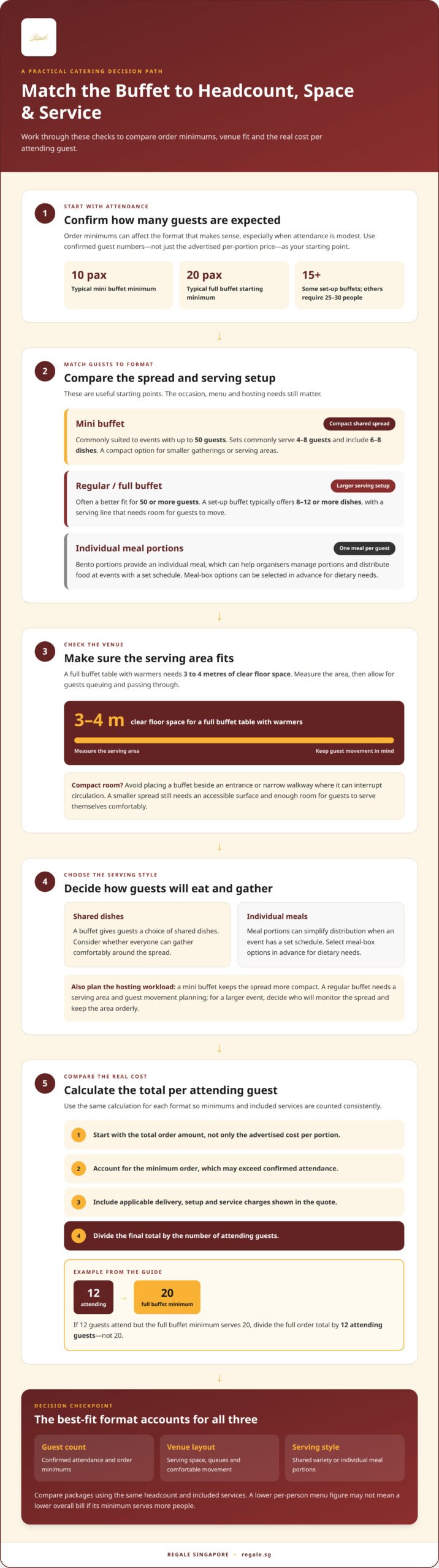
Guest count is only one part of the decision. In Singapore, a mini buffet typically has a minimum order of 10 pax, while full buffet catering typically starts from 20 pax. Set-up buffets may be listed for groups of 15 or more, but some require 25-30 people. These minimums affect the format’s fit, especially when attendance is modest. The mini buffet vs regular buffet choice should also account for the venue, serving style and actual number of people expected.
For example, with 12 confirmed guests, a full buffet minimum of 20 means catering for eight people who aren’t attending. A mini buffet may align more closely with that group size. For a corporate event expecting 30 guests, consider whether the venue has room for a serving table, or whether individual meal portions would keep movement simpler. The mini buffet vs regular buffet comparison becomes more useful when it reflects how guests will gather and eat, rather than headcount alone.
Venue layout can rule out an otherwise suitable format. A full buffet table with warmers needs 3 to 4 metres of clear floor space. Measure the intended serving area, then account for guests queuing and passing through. In a compact room, placing the buffet beside an entrance or narrow walkway can interrupt circulation. A smaller spread still needs an accessible surface and enough room for guests to serve themselves comfortably.
To compare the total cost per guest, use the same calculation for each format:
- Start with the total order amount, not just the advertised cost per portion.
- Account for the minimum order, since it can exceed the confirmed guest count.
- Include applicable delivery, setup and service charges shown in the quote.
- Divide the final total by the number of attending guests.
This calculation shows how minimums affect the amount per attendee. If a package serves 20 but only 12 guests attend, divide its full order total by 12, not 20. For a 30-person corporate gathering, compare packages using the same headcount and included services. A lower per-person menu figure may not mean a lower overall bill if its minimum serves more people.
The price of catering depends on the menu, portions, format and included services, and is given after a quote request. Guest numbers can change, so settle expected attendance before choosing a minimum-order package or a format sized around individual portions. For Singapore events requiring halal catering, halal catering options can also be part of the decision. The practical choice fits the guest count, floor space and serving style without ordering portions the event won’t use.
What Is the Difference Between a Mini Buffet and a Full Buffet?
A mini buffet is a compact shared spread, while a full buffet usually brings more dishes and a larger serving setup. In Singapore, mini buffet sets commonly serve 4-8 guests per set and include 6-8 dishes. Set-up buffets typically feature 8-12 or more dishes, giving groups more choice across a longer dining period. The difference affects more than menu size. It also changes how food is arranged, how guests move, and how much setup the venue needs.
For a gathering of 12-20 people, consider multiple mini buffet sets. This approach keeps the spread in manageable portions and can suit a casual family meal or informal office lunch. Arrange the food in an accessible area, with enough room for guests to approach and serve themselves. A mini buffet setup can be completed in under 15 minutes, making it a practical option where the host wants a simpler arrangement.
A full buffet suits larger groups when the event calls for a broad selection and a defined serving station. For 20 or more guests, a full buffet may require multiple folding tables for 8 to 12 dishes. That footprint can make the format less suitable for a compact home or venue. For a formal event, though, a dedicated buffet line can help organise the meal and present the dishes together.
Setup affects comfort as well as appearance. Place a mini buffet away from doorways and narrow paths so guests can move freely. For a regular buffet, plan a clear route from the serving line to the tables and back to the seating area. If space is limited, check that guests can reach each dish without crowding. The venue layout matters as much as the headcount.
Assess delivery and setup fees separately from the food order. Compare what each quote includes, such as delivery, table setup and equipment, then weigh the total against the event’s needs. A mini buffet usually needs less arranging, while a regular buffet requires more space for its serving display. Compare the full package, not just menu totals, as included setup services can differ.
- Choose a mini buffet when a 4-8-person set or several sets suit the group and available serving area.
- Choose a full buffet when 8-12 or more dishes and a dedicated setup better suit the occasion.
- Before confirming, match the menu, setup requirements and delivery details to the venue’s layout.
In short, mini buffet versus full buffet is a choice between a compact shared meal and a more extensive, structured spread. For 12-20 guests, multiple mini buffet sets may keep serving manageable. For a larger formal gathering, the full buffet’s wider selection may better support the occasion, provided the venue can accommodate its tables.
Mini buffet group size and shared spread
A mini buffet set is commonly planned for 4-8 guests, with 6-8 dishes in each set. That makes the format easier to portion around a smaller gathering than a single, extensive buffet table. For 12-20 guests, consider multiple sets so the spread can serve the group without relying on one compact selection. The key is matching the number of sets and dish quantities to the confirmed headcount, rather than treating every set as a fixed meal for exactly the same appetite.
Plan the spread around how guests will eat. A family lunch where everyone shares dishes needs a different balance from a festive gathering with a longer meal and varied appetites. Mini buffet menus can include hot and cold dishes, savoury and sweet choices, and beverages. Choose a mix that suits the occasion, then consider whether guests will prefer more substantial savoury options or a lighter meal with dessert.
Quantity planning matters as much as dish selection. For a group of 12, account for expected appetite and event duration before deciding whether one set is sufficient or multiple sets are more suitable. The same applies to 20 guests: a short office lunch and an extended family celebration can have different serving needs. Share the guest count, meal timing and event length when quantities are planned. These details help match portions to the gathering and limit excess food.
Consider guest preferences before finalising the menu. A mixed group may include different dietary needs or food preferences, so include those in the menu decision. For a festive meal, balance familiar favourites with variety across the 6-8 dishes. If guests have different appetites, a selection of savoury dishes and sweet options gives them more choice without requiring a separate full buffet spread.
Serving time also affects the shared meal. Penang Culture advises consuming mini buffet food within one hour of delivery. Plan delivery for close to mealtime, rather than leaving the food out well in advance. Arrange the dishes in an accessible spot so guests can serve themselves easily and the host can keep an eye on what remains.
Use this practical sequence for a mini buffet:
- Confirm the group size: Identify whether the gathering fits one 4-8-guest set or calls for multiple sets.
- Describe the occasion: Note whether it is a short lunch, family dinner or festive meal.
- Plan the spread: Balance hot and cold, savoury and sweet dishes around guest preferences.
- Set the timing: Schedule the meal close to delivery and serve promptly.
For groups of 12-20, the clearest takeaway is to plan sets and quantities together. Guest count establishes the starting point; appetite, menu balance and meal duration shape the final shared spread.
Regular buffet food and service options in Singapore
A regular buffet in Singapore is often built around a wider shared selection than a compact set. Set-up buffets typically feature 8-12 or more dishes, while a full buffet for 20 or more guests may need multiple folding tables. The package format can suit celebrations and corporate meals where guests value choice. The exact menu and service arrangement still depend on the selected package, so compare inclusions rather than assuming every buffet offers the same setup.
Start with the menu structure. An 8-12-dish spread can give guests more variety across the meal, but the count alone doesn’t tell you whether it suits your event. Consider the mix of mains, sides and other courses, then match it to the occasion. A formal reception may call for a more extensive selection than a short workplace lunch. For a mixed group, include guest preferences and dietary needs in the menu plan.
Service details affect how much hosting is involved. A set-up buffet provides an arranged spread, while meal boxes give each guest an individual portion. These formats meet different needs: shared dishes suit flexible dining, while individual containers can simplify distribution. Before choosing a package, review what the quote includes, such as delivery, setup, serving equipment and any applicable service charge.
In Singapore, a 10% service charge may be calculated on the total order rather than the actual headcount. That means the final amount can reflect the full order even if fewer guests attend. Include this charge in the comparison, alongside any delivery or setup costs. Calculate the total per attending guest to understand how minimum orders affect the event budget.
Timing and food presentation also matter. Buffet dishes served in chafing dishes can stay warm for up to 2 hours. Plan the meal schedule around delivery and serving time, especially for a programme with speeches or staggered arrivals. Penang Culture advises that full buffet food should be consumed within three hours. Keep the serving area accessible so guests can reach dishes without crossing the main event flow.
- Review the spread: Compare the number and type of dishes against the event’s meal format.
- Match the service: Choose shared buffet dining or individual meal boxes according to how guests will be served.
- Plan the setup: Allow room for tables, warmers and guest movement.
- Check the order total: Account for the service charge, delivery and setup in the final per-guest calculation.
For an event that calls for a shared halal spread, explore halal buffet options as part of your catering plan.
Regale Singapore: Halal Mini Buffet
Regale Singapore offers a Halal Mini Buffet for gatherings that call for a compact shared meal. Menu choices include Nasi Sambal Goreng, Nasi Ambeng and authentic Indonesian cuisine, bringing a distinctive Indonesian spread to family occasions and small events. Choose this format when a compact buffet suits your guest count and venue better than a larger setup.
Choose the format around the event’s serving space and how guests prefer to dine. For a shared meal centred on Indonesian flavours, these dishes offer a clear direction for planning the spread. To discuss a Halal Mini Buffet for your gathering, contact Regale Singapore.
Shape the meal around your gathering
Let the meal support the atmosphere you want to create. A relaxed family occasion may suit a familiar, communal spread, while a hosted event may call for a more structured dining experience. Consider how you want guests to feel, then choose dishes that fit. Catering can help set the tone of an event, not just feed its guests.
The mini buffet vs regular buffet decision can also shape how you present the menu. For a shared meal with Indonesian character, Nasi Sambal Goreng, Nasi Ambeng and authentic Indonesian cuisine offer a clear culinary direction. Choose dishes that suit the gathering and the way guests will dine together. A considered menu brings the food and hospitality together.
Once you have a direction, take the next step and discuss your catering needs with Regale Singapore. A thoughtful choice can make the meal feel like a natural part of the occasion.
Frequently Asked Questions
Decision Guide: Which Should You Choose?
Choose a format that fits your guest list, venue and serving style. For a home gathering, consider whether a compact shared spread fits the room. For a corporate function, decide whether individual portions or a communal meal better suit the programme. Then match the menu and setup to the schedule. A formal reception with space for a serving line may need a different arrangement from a relaxed meal around one table.
What is the difference between a mini buffet and a regular buffet in Singapore?
The mini buffet versus regular buffet distinction is mainly the scale of the spread and setup. Mini buffet sets are commonly designed for 4-8 guests and include 6-8 dishes. Regular set-up buffets typically offer 8-12 or more dishes, with tables and equipment arranged for shared serving. For example, a compact family lunch may suit a mini spread, while a larger formal event may benefit from the broader selection.
How much does a regular buffet cost per person in Singapore?
There is no single standard per-person amount for a regular buffet. The total depends on factors such as menu selection, guest count, minimum order, delivery, setup and applicable service charges. For a useful per-guest figure, divide the full order total by the number of attending guests, not the package minimum. The price of a specific catering order depends on the event and is provided after a quote request.
How are mini buffet and regular buffet food delivered and presented in Singapore?
A mini buffet is delivered as a compact shared spread, while a regular buffet may be arranged across serving tables with warmers. Schedule delivery close to mealtime. According to Penang Culture, mini buffet food should be consumed within one hour of delivery, while full buffet food should be consumed within three hours. Keep the serving point accessible and leave guests enough room to collect dishes without blocking walkways.
Which is better for small parties, office events, and large gatherings in Singapore?
For a small party, a mini buffet makes shared dining practical without requiring a large table setup. Office organisers can choose meal boxes when individual portions or advance dietary selections better suit the programme. For a large gathering, a regular buffet can offer a wider shared selection, if the venue has room for the setup. Match the format to the event’s flow, whether guests are seated, taking staggered breaks or serving themselves.
