
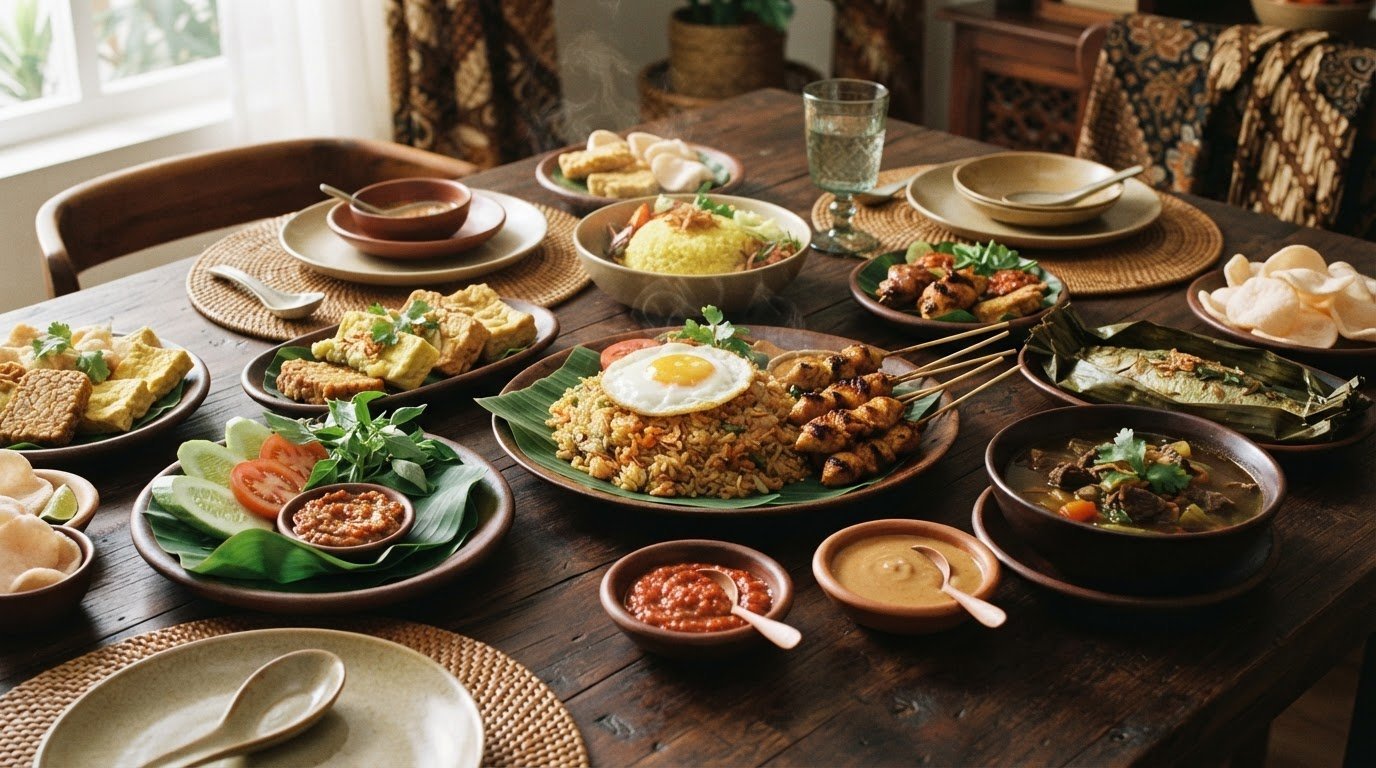

Indonesian food can’t be summed up by one dish or flavour. A guide to Indonesian food for beginners starts with the everyday combinations of rice, vegetables and protein, then explores the sauces, soups and regional traditions that make meals distinct. Across Indonesia’s 17,000 islands, local ingredients and cooking styles shape a wide range of dishes.
If Indonesian dish names and flavours feel unfamiliar, begin with the basics: what people eat for breakfast, how sambal and peanut sauce are used, and which ingredients commonly appear. Knowing these details makes menus easier to understand and helps you choose dishes that suit your tastes.
This guide to Indonesian food for beginners covers familiar dishes such as nasi goreng and nasi uduk, along with regional specialities, common ingredients, soups and stews. It also explains how food traditions vary across Indonesia, so you can build your understanding one dish at a time.
Key Takeaways
- Recognise familiar breakfast dishes such as nasi goreng and nasi uduk, and notice how their accompaniments shape each meal.
- Use sambal, peanut sauce and coconut milk as clues to a dish’s flavour, texture and serving style.
- Compare regional traditions to understand why Indonesian dishes can range from sweet and mild to rich and intensely spiced.
- Explore how rice, vegetables and protein come together, along with preparations such as banana-leaf-wrapped pepes.
- Distinguish comforting soups and stews by their defining ingredients, from rawon’s dark broth to bakwan Malang’s meatballs.
1. Common Indonesian breakfast dishes
Indonesian breakfasts can be savoury, filling and built around rice. Nasi goreng, or fried rice, is a common homemade morning dish, often seasoned and served with accompaniments such as egg. Nasi uduk offers another option: rice cooked in coconut milk and paired with items such as egg, fried noodles, chicken, tofu or tempeh. Both are approachable first choices, with a familiar base and distinct Indonesian flavours.
Vegetables feature in breakfast and other everyday meals. Gado-gado combines vegetables with ingredients such as hard-boiled egg, potato, tofu and tempeh, then brings them together with peanut sauce. Depending on its accompaniments, it can be a light salad or a more substantial meal. For a first taste, try the vegetables and sauce separately, then combine them to see how the nutty, savoury dressing changes each bite. Sambal can add chilli heat, so taste a little before mixing it in.
The cost of meals in Singapore and Indonesia varies by location, venue, portion size and whether you choose street food or a restaurant. Compare serving types and sizes rather than assuming there is one typical price across both countries.
Manado food is known for bold chilli flavours, offering a contrast to milder breakfast dishes. Tinutuan, also called Manado porridge, is a savoury rice porridge commonly made with vegetables. Rica-rica is a chilli-forward seasoning used with ingredients such as chicken or fish. If you are new to spicy food, start with the porridge or a small taste of a spicy dish, then adjust the sambal to your preference. These dishes show how vegetables and heat can define a meal as much as its main ingredient.
Balinese food traditions include dishes for family gatherings and feasts, as well as everyday meals. Nasi campur, rice served with a selection of side dishes, lets diners sample several flavours together. Babi guling is a Balinese pork dish, so it is not suitable for diners seeking halal food. Bali’s satay lilit is another regional example, made with seasoned minced meat wrapped around a skewer. Check which meat is used, as versions can differ.
Approachable choices for beginners include nasi goreng, nasi uduk, gado-gado and satay, each offering a clear introduction to rice, vegetables, sauce or grilled protein. Breakfast may include fried rice or coconut-milk rice; lunch often pairs rice with vegetables and a protein dish; dinner can feature regional specialities and shared sides. These are common patterns, not fixed rules: nasi goreng, for example, can be eaten at different times of day.
2. Sambal, peanut sauce and coconut milk
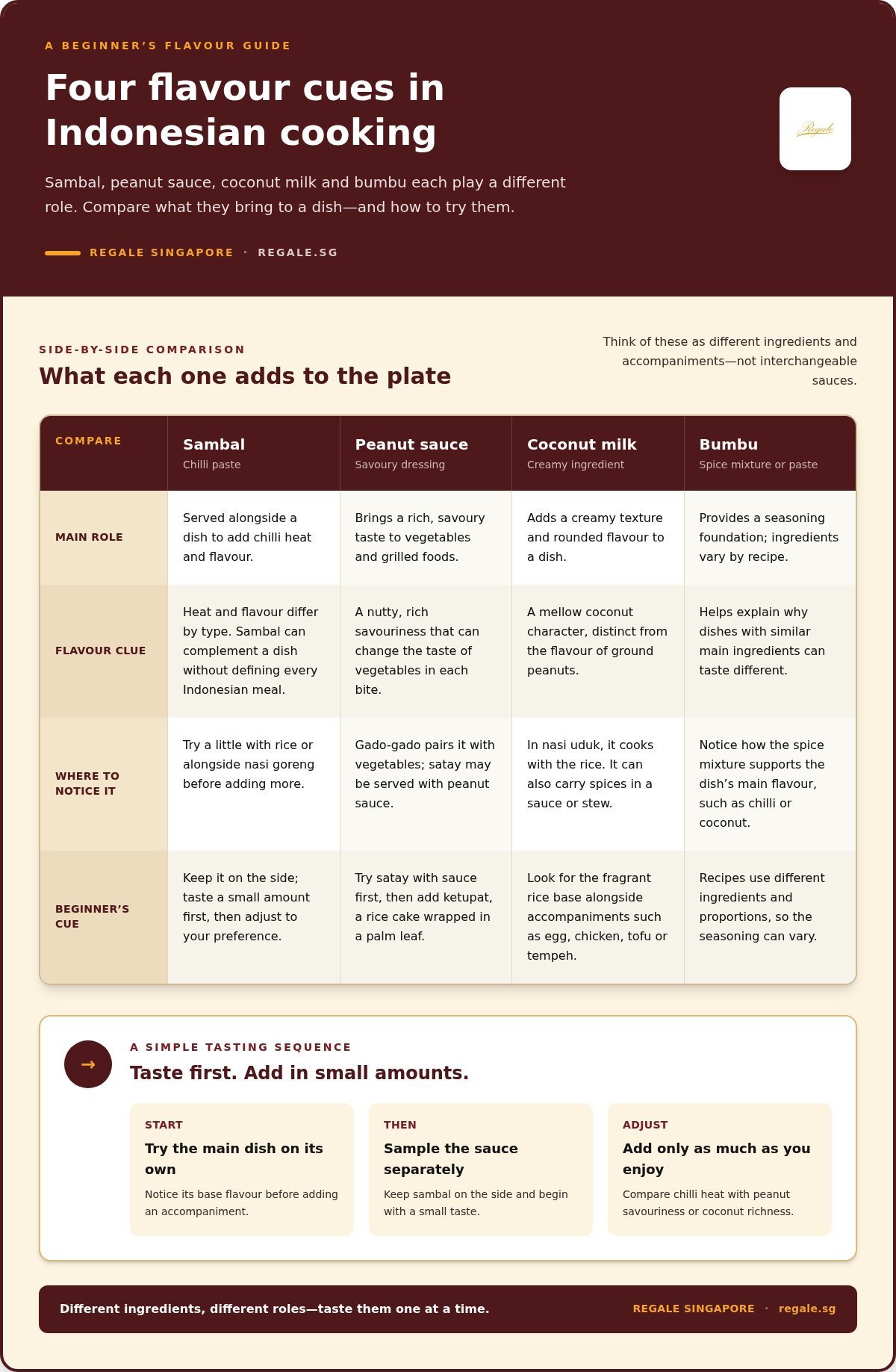
Sambal is a chilli paste served alongside Indonesian dishes, not a sauce that has to be poured over everything. Its heat and flavour vary by type, and different sambals pair with different foods. Start with a small amount on the side, taste it with rice, then add more if you like. This lets the chilli complement the dish without masking its other flavours.
Chilli tolerance is personal, so treat sambal as an adjustable accompaniment. Try a small taste before mixing it into nasi goreng or another main dish. Notice how its heat develops as you eat, then use more or less with each bite. Sambal can bring brightness and warmth, but it is only one part of Indonesian cooking, not the defining flavour of every dish.
Peanut sauce offers a different balance: rich, savoury and often paired with vegetables or grilled foods. Gado-gado combines the sauce with vegetables and other accompaniments. Satay is often served with peanut or soy sauce and may come with ketupat, a rice cake wrapped in a palm leaf. Try a piece of satay with sauce first, then add ketupat to see how the rice cake softens the overall flavour.
Coconut milk gives dishes a creamy texture and rounded flavour. In nasi uduk, it cooks with rice to create a fragrant base for accompaniments such as egg, chicken, tofu or tempeh. In other recipes, it carries spices through a sauce or stew. Coconut milk is distinct from peanut sauce: one brings a creamy coconut character, while the other has the flavour of ground peanuts.
Spices add another layer of flavour. Indonesian cooks use bumbu, a prepared spice mixture or paste, as a foundation for seasoning dishes. Ingredients and proportions vary by recipe, which helps explain why chicken dishes can taste so different from one another. When tasting a dish, identify its main flavour first, such as chilli, coconut or peanut, then notice how the spice mixture supports it.
For a first tasting, keep sambal separate, sample the main dish, and add the sauce in small amounts. This simple sequence helps you distinguish chilli heat from the savoury depth of peanut sauce or the mellow richness of coconut milk. Satay with peanut or soy sauce provides a familiar starting point. To experience Indonesian flavours in Singapore, explore Indonesian dining options.
3. Regional food traditions
Indonesian cuisine reflects local cultures, ingredients and outside influences. The country is home to over 300 ethnic groups, and each region has developed distinctive tastes. A dish’s name can point to its place of origin, but recipes and serving styles also vary locally. For beginners, compare regional dishes by their staple, seasoning and cooking method rather than expecting one flavour profile across every island.
West Sumatra is known for rich, intense flavours built from spice blends. Dishes there are often cooked with oil or coconut milk, creating deeply seasoned meals. Central Javanese cuisine generally has milder heat and often tastes sweet. These contrasts explain why dishes with similar ingredients can taste quite different: regional traditions shape both seasoning and preparation.
Rice is not the only staple across the archipelago. In parts of eastern Indonesia, taro, sweet potato or cassava are more common everyday staples than rice. This shapes what is served alongside stews, vegetables and protein. Tempeh, made from fermented soybeans, appears in meals across Indonesia, while noodles feature in particular dishes and local interpretations. Look at the staple first to understand how a regional plate is put together.
Named dishes offer a practical introduction to local traditions. Yogyakarta gudeg combines unripe jackfruit with thick coconut milk and palm sugar, and is often served with chicken, eggs, tofu, tempeh and sambal krecek. Bandung siomay pairs steamed fish dumplings with potatoes, bitter melon, cabbage, tofu and peanut sauce. Semarang lumpia is a spring-roll-inspired dish, with fillings such as bamboo shoots, minced chicken, scrambled eggs and dried shrimp.
Regional identity can shape both ingredients and dietary suitability. In Aceh, where Islam is strongest, pork is not used in local cuisine. By contrast, Balinese satay lilit is commonly made with pork and seasoned with lemongrass, galangal, chilli and lime leaves. For food safety, choose freshly prepared food served hot. For allergy awareness, note ingredients such as peanuts in siomay sauce, soy in tempeh and fish in dumplings.
To explore regional food, begin with a familiar staple, then add one local dish or sauce. A dish’s name, ingredients or seasoning may give clues to its region. Warteg, short for warung Tegal, typically serves Javanese home-style meals, showing how vegetables, rice and protein come together in everyday cooking. Compare a plate there with gudeg or West Sumatran cooking to spot regional differences.
4. Vegetables, poultry, meat and fish
Indonesian meals often bring several food groups together rather than treating vegetables as an afterthought. Households commonly serve at least 3 types of food: rice, vegetables and a protein dish. A guide to Indonesian food for beginners can use this pattern to help build a plate: choose a staple, add vegetables, then select chicken, meat or fish. Boiled egg can also provide protein, while fried shallots add a savoury finish. The combination changes by household and region.
Pempek, a Palembang fish cake made from ground fish and tapioca, offers another way to explore Indonesian food. It is commonly served with kuah cuko, a sweet-and-sour sauce, alongside cucumber slices and noodles. Taste the sauce with a small piece first, then try the cucumber and noodles with the fish cake. This helps you notice how the tangy accompaniment balances pempek’s firm, springy texture.
Chicken, duck and fish can be prepared in different ways, including frying. A crisp coating contrasts with tender poultry, while fried fish adds crunch to a meal built around rice and vegetables. Try a plain piece before adding sambal or another sauce. This makes it easier to distinguish the meat’s seasoning from the heat or sweetness of its accompaniment.
Grilled fish and seafood offer another way to experience Indonesian cooking. Grilling browns the outside as the fish cooks through, while sauces or spice pastes add flavour. First identify the fish or seafood, then try a small bite of the seasoned exterior and a piece of the flesh. This highlights the contrast between the cooking method and the seasoning.
Beef rendang shows how time and spices can transform meat. Traditional rendang is cooked with beef, spices and coconut milk for about 7-8 hours. The long cooking develops concentrated flavour and a rich coating around the beef. Try a small portion with plain rice, then add vegetables to balance the dish’s intensity. Rendang is a slow-cooked example, distinct from fried or grilled preparations.
Pepes demonstrates a different technique for meat, fish or vegetables. The ingredients are wrapped in banana leaf and then steamed or grilled. This preparation contrasts with open frying or direct grilling. A guide to Indonesian food for beginners can compare pepes with fried fish by noting the cooking method, main ingredient and seasoning. Across these dishes, each element helps shape the meal.
5. Indonesian soups and stews
Broth-based soups and slowly cooked stews offer different ways to experience Indonesian cuisine. A soup’s broth carries seasoning through each spoonful, while a stew often centres on ingredients cooked together until their flavours deepen. Rawon and bakwan Malang show how varied these dishes can be. Compare the broth, main ingredient and toppings to understand each bowl before adding seasoning.
Rawon, associated with Surabaya, is a beef soup known for its rich flavour and distinctive black colour. Kluwek gives the broth its characteristic appearance and taste. For your first serving, taste a spoonful of broth before eating the beef and rice together. This helps you notice the kluwek separately from the meat and other ingredients.
Bakwan Malang comes from Malang and centres on meatballs served in warm broth. It often includes fried wontons and may also come with vermicelli, green onions and fried shallots. Try a meatball first, then sample the broth with a little vermicelli. Wontons add contrasting texture, while green onions and shallots bring more savoury notes to the bowl.
These examples show why a soup’s ingredients matter as much as its name. Rawon is defined by kluwek in a dark, rich broth; Bakwan Malang is recognised by its meatballs and assortment of additions. In a restaurant, identify the main component first, then notice how noodles, wontons or garnishes change the balance. This gives beginners a simple way to compare dishes without treating every Indonesian soup as the same style.
Stews can also bring together meat, spices and coconut milk through slow cooking. Traditional rendang, for example, uses beef, spices and coconut milk, cooked for about 7-8 hours. Its concentrated texture differs from the warm, spoonable broth of rawon or Bakwan Malang. If a menu offers a stew, look for its central ingredient and cooking style, then pair a small portion with rice to appreciate its seasoning.
For a first tasting, take the dishes in stages: sample the broth, try the main ingredient, then add the accompaniments. With rawon, begin with kluwek-rich broth; with Bakwan Malang, compare meatballs, wontons and vermicelli. These steps help reveal how each bowl is composed. To continue exploring Indonesian flavours in Singapore, discover authentic Indonesian cuisine.
Bakwan Malang is a meatball dish from Malang, served in warm broth, often with fried wontons and sometimes with vermicelli, green onions and fried shallots. For a first bite, focus on one element at a time rather than combining everything immediately. A plain taste of the meatball gives you a starting point; a spoonful with broth lets you consider the pairing. If the bowl includes other additions, try them separately before deciding what to combine.
Use the bowl as a simple exercise in balance: compare a bite with a wonton to one with vermicelli, then see whether green onions or fried shallots change your preference. There is no need to add every accompaniment to each mouthful. Pausing between combinations makes it easier to notice which textures and flavours stand out. For a simpler taste, begin with the meatball and broth, then add one accompaniment at a time. This keeps the tasting relaxed and lets you choose your preferred mix.
Regale Singapore: Nasi Sambal Goreng
Regale Singapore serves Nasi Sambal Goreng, a way to continue exploring Indonesian food over a meal. Having learned about sambal, regional flavours and shared meals, you can use this dish to put those ideas into practice. Nasi Ambeng and authentic Indonesian cuisine offer more ways to explore, while Western dishes provide a different option on the menu.
Choose Regale Singapore when you’re ready to move from learning about Indonesian food to enjoying it over a meal. The dishes in this guide can help you recognise ingredients and flavours as you explore the menu.
For an Indonesian meal in Singapore, visit regale.sg or contact Regale Singapore.
Make your next meal a starting point
A guide to Indonesian food for beginners can do more than explain unfamiliar names. Use it to shape your own tasting path: choose a dish that catches your attention, notice which flavours you enjoy, and let that guide what you try next. You do not need to master every regional speciality at once.
Regale Singapore serves Nasi Sambal Goreng, Nasi Ambeng and authentic Indonesian cuisine. These dishes give you a place to continue exploring Indonesian food over a meal, whether you want to revisit a favourite or discover something new. Let curiosity set the pace and treat each new flavour as an invitation to learn more.
Contact Regale Singapore to plan your next Indonesian meal. Enjoy exploring the cuisine, one dish at a time.
Frequently Asked Questions
What are the main ingredients and flavors in Indonesian cuisine?
Rice, vegetables, tofu, tempeh, fish, meat, spices and sauces feature across Indonesian meals. Flavours can be savoury, sweet, sour, rich or chilli-hot, and combinations vary by dish and region. For a first tasting, choose a familiar base such as rice, then try a side or sauce separately. This makes it easier to notice how ingredients like coconut milk, peanuts or chilli shape the overall taste.
Which Indonesian dishes are spicy, and how can I order milder versions?
Manado dishes and foods seasoned with sambal can bring pronounced chilli heat, while Central Javanese cuisine is often milder and sweeter. Ask for sambal on the side or request less chilli when ordering, so you can taste the dish before adding heat. Rica-rica is another chilli-forward seasoning, making it more suitable for diners who enjoy stronger spice than those looking for a gentler introduction.
What are common Indonesian vegetarian and vegan dishes?
Gado-gado is a familiar vegetable-based choice, often made with tofu, tempeh, potato and peanut sauce. Tempeh and tofu can also be served as sides or included in a larger meal. These dishes are not automatically vegan: gado-gado may include hard-boiled egg, and sauces or seasonings can contain animal ingredients. If you avoid these, ask which ingredients are used and request suitable omissions before ordering.
What are Indonesian street food favorites, and how can beginners choose safe stalls?
Start with familiar street-food options such as satay, martabak or gado-gado, choosing according to whether you prefer grilled, sweet or vegetable-led dishes. For a more comfortable first experience, look for food prepared fresh and served hot, and stalls where ingredients and utensils appear clean and covered. These are practical selection cues, not a guarantee of safety. If you have allergies, ask about ingredients before ordering.
What Indonesian dishes should beginners try in Singapore?
For a first taste, try Nasi Sambal Goreng or Nasi Ambeng at Regale Singapore, alongside its authentic Indonesian cuisine. These dishes offer a way to explore Indonesian flavours in a local dining setting. If you’re new to sambal, taste a small amount first and adjust to your preference. Choose Nasi Ambeng to experience another traditional Indonesian meal.
