
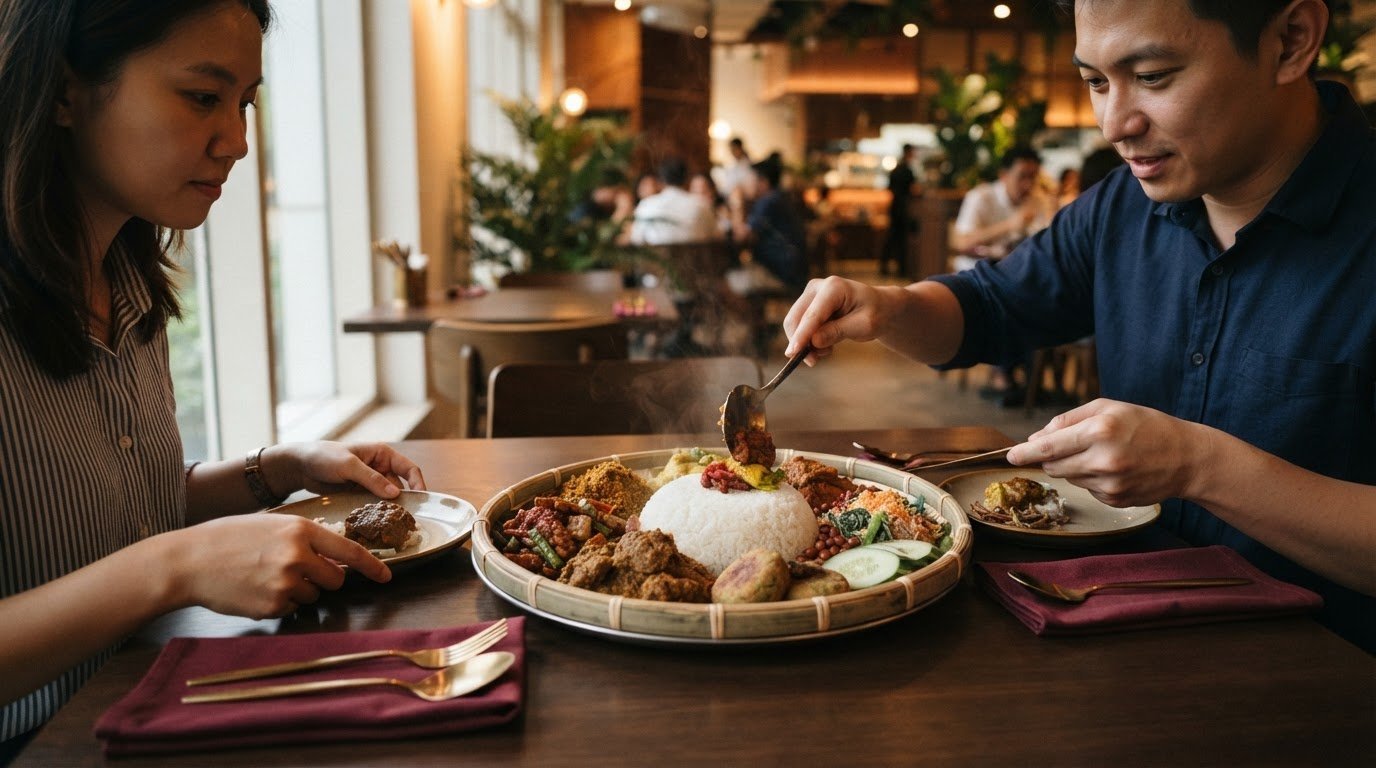

Singapore’s Indonesian food scene brings together Javanese, Padang and Sulawesi traditions. Nasi ambeng offers a distinctive introduction to Javanese cooking. The National Library Board Singapore notes that it has roots in traditional Javanese rituals and appears in different versions across Singapore. For anyone exploring authentic Javanese cuisine in Singapore, regional dishes are a useful starting point.
Planning a visit also means finding a venue and time that suit your day. This guide explores authentic Javanese cuisine in Singapore alongside Padang and Sulawesi dishes, with restaurant locations and opening hours to help you plan. It also outlines key menu differences and useful cultural context, so you can choose a dining experience that fits your interests and schedule.
Key Takeaways
- Learn how nasi ambeng connects Javanese food with shared dining traditions in Singapore.
- See how Javanese, Padang and Sulawesi dishes differ to help narrow down what to try.
- Use restaurant locations and opening hours in the guide to plan a visit around your schedule.
- Understand what menu details and diner impressions can reveal when exploring regional Indonesian cuisine.
- Discover a Singapore dining option serving Indonesian favourites alongside Western cuisine.
3. Which Singapore restaurants specialize in traditional Javanese cuisine?
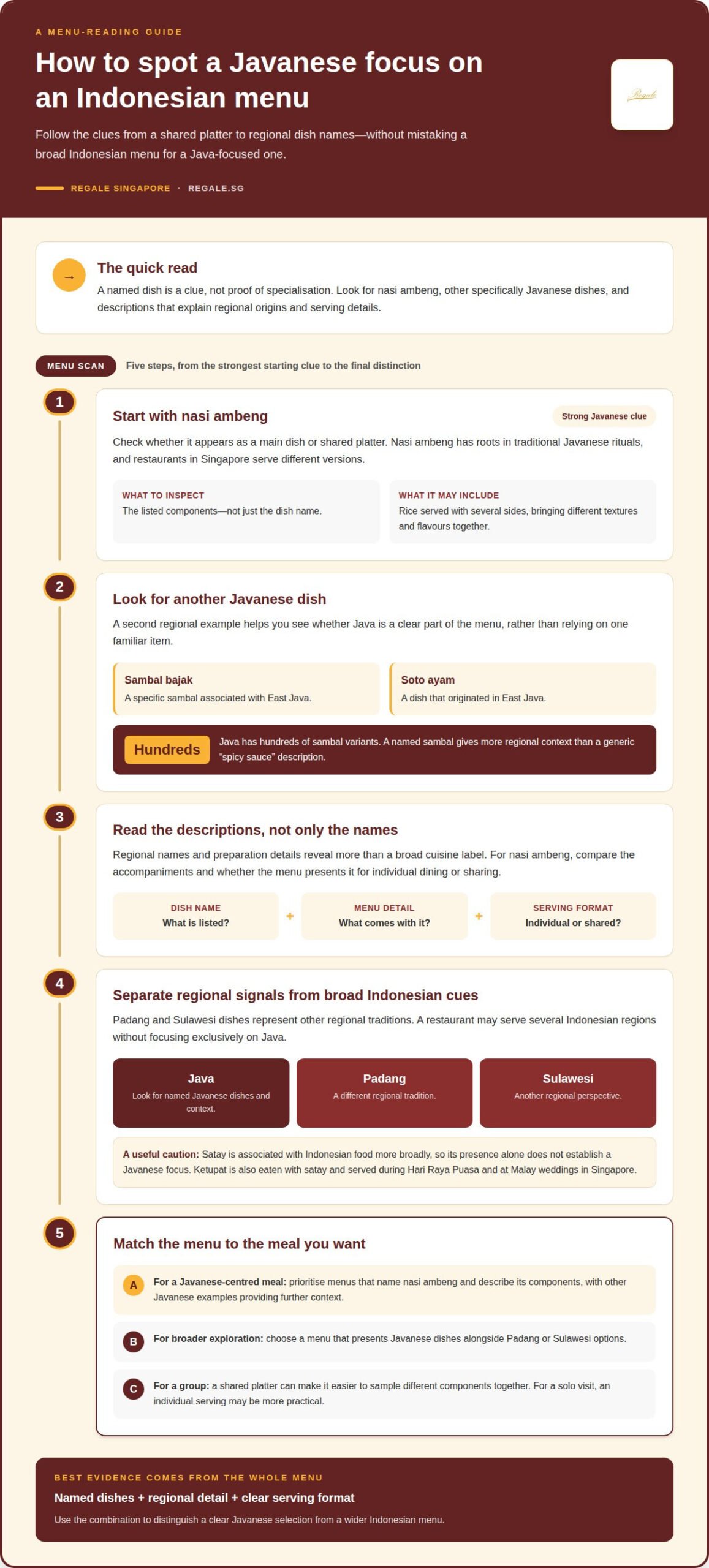
In Singapore, look for Indonesian menus that feature Javanese dishes such as nasi ambeng, rather than relying on a broad Indonesian label alone. The National Library Board Singapore notes that nasi ambeng has roots in traditional Javanese rituals and that restaurants in Singapore serve different versions. A menu featuring this shared platter is a practical clue when identifying a Javanese focus.
Nasi ambeng is useful for comparing menus because its components can vary. A serving may bring rice together with several side dishes, offering contrasting textures and flavours in one meal. Compare the listed accompaniments, not just the dish name. Those details show how the platter is presented and whether it suits a group looking to share a meal.
Other menu clues include familiar Indonesian preparations with regional context. Sambal, for example, comes in many forms across Java, which has hundreds of sambal variants. A menu that names a particular sambal or explains its role gives more information than a generic reference to spicy sauce. Sambal bajak, associated with East Java, is one specific regional example.
Distinguish a Javanese focus from a general Indonesian menu. Padang dishes represent a different regional tradition, while Sulawesi food offers another perspective. A restaurant may serve a range of Indonesian dishes without focusing exclusively on Java. Read descriptions for regional names and preparations, then consider whether Javanese dishes form a clear part of the menu.
Use a simple sequence when choosing a menu. First, see whether nasi ambeng appears as a main dish or shared platter. Next, look for other Javanese examples, such as East Javanese sambal bajak or soto ayam, which originated in East Java. Then compare how the menu describes these dishes. Clear descriptions help distinguish a regional selection from a menu using broad cuisine labels.
Satay adds context, but its presence alone doesn’t establish a Javanese focus. Satay is associated with Indonesian food more broadly, and its history in Singapore crosses regional boundaries. Ketupat, often eaten with satay, is also served during Hari Raya Puasa and at Malay weddings in Singapore. These examples show why one familiar dish offers limited evidence of specialisation.
For a meal centred on Javanese food, prioritise menus that name nasi ambeng and describe its components. For broader exploration, choose an Indonesian menu that presents Javanese dishes alongside Padang or Sulawesi options. This distinction sets expectations before you dine and helps you choose a shared platter, a regional tasting, or a meal focused on one tradition.
4. What are the prices and menus at Javanese restaurants in Singapore?
Javanese restaurant menus in Singapore vary, so there is no single price that applies across venues. Start comparisons with the menu format: an individual rice meal, a shared platter, or a broader selection of regional dishes. Check what each format includes before comparing listed prices. The dish name alone may not tell you the portion size or accompanying items.
Nasi ambeng is one menu item to examine closely. Restaurants offer different versions, as the National Library Board Singapore notes. Compare the components described on each menu, then see whether the platter is intended for individual dining or sharing. This helps you understand what the listed price covers without assuming every restaurant serves the same combination.
Menu descriptions also help distinguish Javanese dishes from wider Indonesian selections. A restaurant may serve food from Java alongside Padang or Sulawesi dishes. Look for regional names and specific dish descriptions, rather than treating every Indonesian menu as identical. This distinction matters when you want to explore one regional tradition.
For a practical comparison, review these details together:
- Meal format: Identify whether the dish is listed as an individual serving or a shared meal.
- Included components: Note which sides or accompaniments the menu describes.
- Regional focus: Separate Javanese dishes from Padang or Sulawesi options.
- Menu scope: See whether the restaurant focuses on Indonesian food or offers other cuisine too.
These details explain why prices differ between menus, but they don’t establish a universal benchmark. A shared platter and an individual dish are different dining formats. Their listed prices aren’t directly comparable unless the menu explains portions and inclusions. A broad regional menu may offer more choices than a focused selection, but variety alone doesn’t indicate value.
Before choosing, decide what kind of meal suits the occasion. For a group, a shared format can make it easier to sample different components together. For a solo visit, an individual serving may be more practical. Then compare the descriptions and prices for that format. This keeps the decision centred on what diners will receive, rather than a number viewed without context.
Opening hours and service periods can also shape menu choices. A restaurant may offer different selections at different times of day, so check the menu for the period you plan to visit. Use the stated operating hours to plan your arrival, then review the dishes listed for that meal period. This helps avoid choosing a venue based on food unavailable at your planned time.
For diners comparing Singapore menus, the most informative descriptions give clear dish names, regional context and serving format. If descriptions are brief, use the named dishes as a starting point, not proof that every venue prepares them identically. Comparing format, components and regional range gives you a clearer basis for choosing a meal than an unsupported price estimate.
For a meal that pairs Indonesian dining with another cuisine option, explore Indonesian dining options in Singapore.
Menus may include individual rice meals, shared nasi ambeng platters, and dishes from Java alongside Padang or Sulawesi selections. Prices vary according to the format and what it includes, so compare portions and accompaniments rather than expecting one standard price.
4. How do Singapore diners rate Javanese restaurants for authenticity
Singapore diner ratings can indicate overall satisfaction, but a star score alone cannot establish Javanese authenticity. Read reviews for specific details about dishes, preparation and regional identity. A comment that names a dish and describes its flavours gives more useful context than a brief “good food” rating. Treat the score as one clue, then look for the reasons behind it.
Start by separating feedback about food from feedback about service. A review might praise attentive staff but say little about the meal. Another may describe the balance of a sambal or the components of nasi ambeng. These comments address different aspects of a visit. When assessing authenticity, give more weight to reviews that explain what diners ate and how the dishes were presented.
Look for recurring specifics across independent reviews instead of relying on one enthusiastic or critical account. Several diners naming the same regional dish, for example, give a clearer picture of a restaurant’s menu focus. Descriptions of ingredients, accompaniments and flavour offer more substance than general claims of “authentic” or “traditional.” Repeated concrete details help distinguish informed feedback from broad impressions.
- Dish detail: Does the review name the food and describe its components?
- Regional context: Does it identify a Javanese dish rather than Indonesian cuisine generally?
- Experience: Is the comment about taste, service, portion, or dining format?
- Consistency: Do separate reviews describe similar strengths or concerns?
Context matters when comparing ratings. A family reviewing a shared meal may focus on serving style and suitability for a group. A solo diner may discuss portion size or service speed. Neither perspective alone defines authenticity. Read each review in light of its stated purpose, and distinguish practical preferences from observations about regional cooking.
Pay attention to balanced criticism as well as praise. A review explaining a specific concern, such as seasoning or a dish description that differed from expectations, is more useful than a one-line complaint. Positive feedback is also more meaningful when it explains what stood out. These details help you judge whether the reviewer’s priorities match your dining plans.
Ratings reflect the whole visit, not just the recipe. Seating, waiting time and staff communication can influence a diner’s overall impression. Keep these points separate from comments about food. If a review discusses both, note which part concerns the restaurant experience and which relates to the menu. This prevents a service issue from being mistaken for a judgment about Javanese cooking.
Use a simple process before choosing a venue. First, scan recent reviews for named dishes and regional descriptions. Next, compare recurring observations across different diners. Finally, separate comments about food from remarks about service or convenience. This gives you a more grounded view than ranking restaurants by one score and helps you find a dining experience that suits your interest in Javanese cuisine.
5. Are there Javanese food stalls or markets in Singapore
Yes, Javanese food is accessible in Singapore, although finding it may involve looking beyond stalls labelled specifically “Javanese.” The National Library Board Singapore states that Singaporean-Javanese can easily access authentic Javanese food locally. At a food centre or market, Indonesian dishes may appear within a wider menu rather than under a dedicated regional heading.
The setting matters when planning a meal. A market brings together separate food vendors, while a restaurant presents its menu through one dining venue. A stall might offer a small selection of Indonesian dishes alongside other food, whereas a restaurant may provide a broader seated dining experience. Decide which setting suits your meal before choosing where to eat.
At a stall, start with the menu board and look for named Indonesian dishes, not just general labels such as “rice” or “spicy food.” A clear dish name helps you understand what is served. If the board uses broad regional wording, read the descriptions carefully. Menu wording can help distinguish a particular Javanese dish from Indonesian food more generally.
Markets can suit a flexible meal, especially when diners want to browse several counters. A restaurant may be more practical for a planned sit-down meal or a group dining together. These are different formats, not measures of authenticity. A modest stall menu may focus on a few dishes, while a restaurant can present a wider range.
- For a quick meal: Browse stall menus for a named Indonesian dish and a clear serving description.
- For a group: Consider whether a shared restaurant setting better suits the occasion.
- For regional discovery: Look for menu descriptions that identify Javanese food specifically.
Opening hours also shape your choice. A stall’s service period may differ from those of nearby vendors, while a restaurant follows its own operating schedule. Plan around the venue you intend to visit instead of assuming a whole market serves every dish throughout the day. This is especially useful when a particular meal is the main reason for the trip.
For a more focused search, use the dish name as your guide. If you want Javanese food, look for menus that identify the cuisine or describe a dish’s regional connection. A menu presenting Indonesian food broadly may still have an option worth considering, but its regional focus can differ. This distinction helps set expectations before you arrive.
Singapore offers access to Javanese food through different dining settings, from market counters to restaurants. The National Library Board Singapore supports the broader point about local access, while the specific venue determines the format and menu. Choose based on whether you value browsing, a focused menu, or a seated meal. For a restaurant-based Indonesian dining experience, explore Indonesian cuisine in Singapore.
Regale Singapore: Authentic Indonesian Cuisine
Regale Singapore offers an authentic Indonesian dining experience for visitors seeking Javanese-inspired dishes in Singapore. The menu includes Nasi Ambeng and Nasi Sambal Goreng, bringing familiar Indonesian flavours to a full-service restaurant. The all-day menu also features Western and local favourites, giving diners with different tastes options to enjoy.
Choose Regale Singapore when you want a seated meal featuring Indonesian cuisine rather than browsing market stalls. Its evening dining experience centres on Indonesian food, while daytime visitors can choose from Western and local favourites. The menu’s Nasi Ambeng also connects naturally with the shared dining tradition discussed in this guide.
Contact Regale Singapore to plan your visit.
Make Your Next Meal a Cultural Experience
Choosing where to eat can shape the atmosphere of a gathering. Exploring authentic Javanese cuisine in Singapore gives diners a way to connect over regional food and tradition. Consider the occasion, your guests’ preferences, and whether a restaurant visit or catered gathering better fits your plans.
For an event centred on authentic Javanese cuisine in Singapore, Regale Singapore offers Indonesian cuisine and halal catering. Its Nasi Ambeng and Nasi Sambal Goreng provide options to consider when planning a shared meal. Think about the setting and dining format that will suit your guests, then contact Regale Singapore to plan your event. An authentic Javanese cuisine in Singapore experience can be a welcoming centrepiece for your gathering.
Frequently Asked Questions
Where can I find authentic Javanese restaurants in Singapore?
Look for Singapore menus that identify Javanese dishes by name. Nasi ambeng is a useful starting point, while a broad Indonesian menu may also include food from other regions. Regale Singapore serves Indonesian cuisine at Regale at Science Centre. For a planned visit, use the venue’s current menu and stated opening hours to choose a suitable dining time and setting.
What are the most popular Javanese dishes available in Singapore?
Nasi ambeng is a well-known Javanese choice in Singapore, and menus may also feature dishes such as nasi sambal goreng or soto ayam. For a first visit, choose according to the meal you want: a shared platter, a rice-based dish or soup. Regale Singapore offers Nasi Ambeng and Nasi Sambal Goreng, giving diners two named Indonesian options to consider.
What are the differences between Javanese and other Indonesian cuisines in Singapore?
Javanese, Padang and Sulawesi cuisines refer to distinct Indonesian regional traditions, so a broad Indonesian label doesn’t identify one specific style. Java has hundreds of sambal variants, and sambal bajak is associated with East Java. In Singapore, compare menus by their named dishes and regional descriptions. This helps distinguish a Javanese selection from a menu drawing on several Indonesian regions.
