
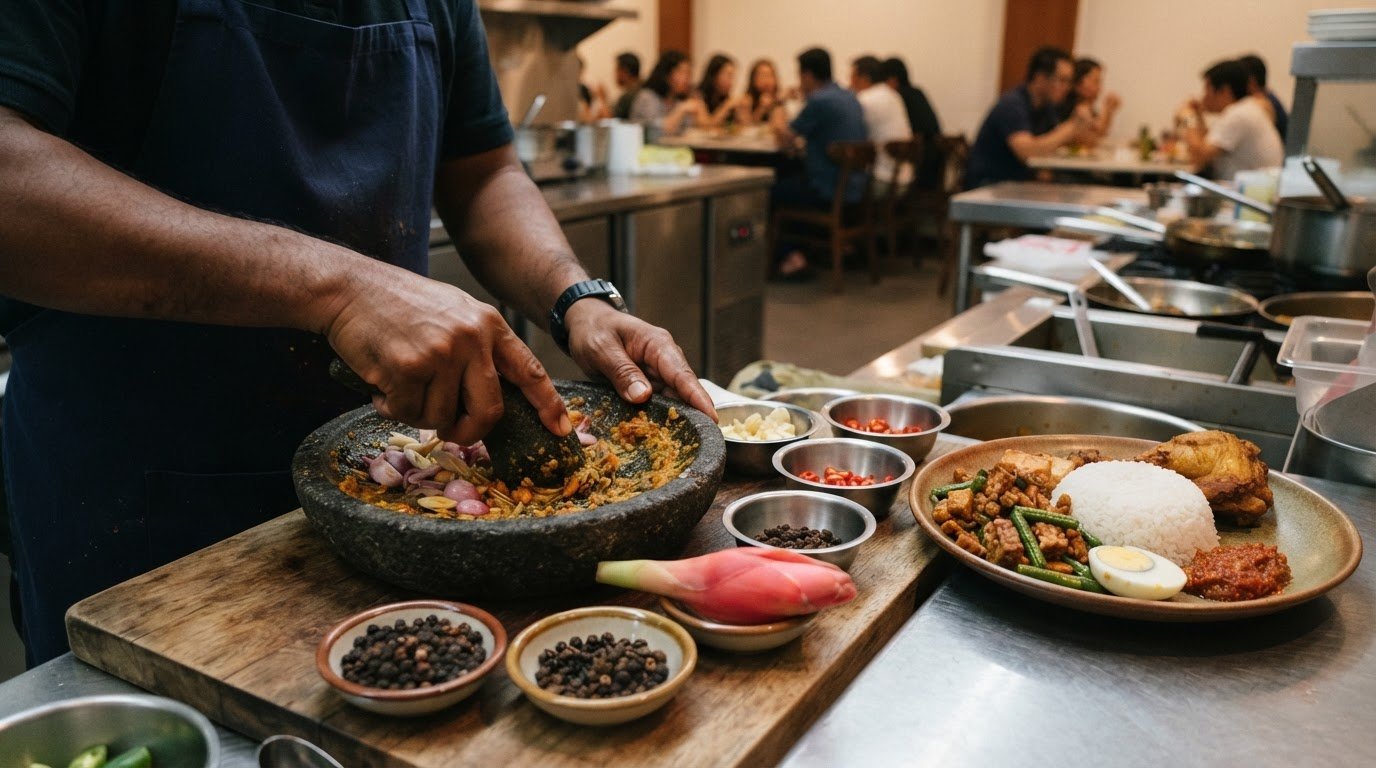

Indonesian food gets its character from balance, not heat alone. Understanding Indonesian spices and their uses means seeing how aromatics, herbs and distinctive ingredients build fragrance, depth and contrast in regional dishes. Shallots, lemongrass, turmeric and other ingredients are often ground together into bumbu, a fragrant paste used as a cooking base.
Familiar spices are easy to recognise, but less common ingredients can be harder to place. Cubeb brings a bitter, refreshing note with little heat, while andaliman appears in Batak dishes such as arsik and saksang. Torch ginger adds its own character to dishes including arsik, salads and sambals.
This guide explains how these ingredients taste and how cooks use them, from the aromatic foundation of shallots and lemongrass to the regional roles of andaliman and torch ginger. It also explores how spice pastes vary across Indonesia and how familiar seasonings such as coriander, cumin and turmeric contribute to the dishes they shape.
Key Takeaways
- Learn how cubeb’s distinctive flavour works in Indonesian cooking and which ingredients complement it.
- Recognise how Indonesian ingredient names connect to familiar English terms and cooking roles.
- See how shallots and lemongrass form an aromatic foundation for many dishes.
- Explore where torch ginger and andaliman appear in regional cooking, including Batak dishes.
- Use these flavour cues to better understand the character of Indonesian dishes such as Nasi Ambeng and Nasi Sambal Goreng.
Cubeb pepper’s flavor and culinary uses
Indonesian cooks use cubeb for its distinctive, low-heat character, especially in gulai curries. Rendang, nasi goreng and satay draw on aromatic ingredients such as garlic, ginger, turmeric, lemongrass and chilli, with coriander and cumin also common. The combinations vary by dish.
Cubeb Pepper’s Flavor Profile
Cubeb pepper has little heat and a bitter, refreshing flavour with a slightly numbing finish. It adds character without making a dish depend on chilli heat. In a spice blend, cubeb can bring a cool, aromatic contrast to richer ingredients, making the seasoning feel layered rather than simply hot.
Native to Java, cubeb is used in gulai, a family of Indonesian curries. Its flavour is more distinctive than a straightforward peppery bite, so it works best in a blend rather than as the only seasoning. In gulai, other spices and aromatics contribute fragrance and depth alongside it.
Nutmeg, orange peel, lemongrass and cloves pair well with cubeb. Each contributes a different note: lemongrass is fragrant, cloves are pungent and nutmeg is warm. Orange peel adds a bright citrus quality. Together, they can give curry seasoning more complexity than cubeb alone.
For home cooking, use cubeb as a supporting spice in a ground blend or paste. Pair it with familiar ingredients such as lemongrass and cloves, then balance the dish with its other seasonings. This lets cubeb’s bitter, refreshing quality come through without overwhelming the curry.
Spices for Rendang, Nasi Goreng, and Satay
Rendang, nasi goreng and satay all draw on aromatic ingredients, but they don’t share one fixed spice formula. Garlic, ginger, turmeric, lemongrass and chilli are useful foundations, while coriander and cumin are common Indonesian spices. Knowing these building blocks helps explain how seasoning varies by recipe and region.
For rendang, think of a fragrant spice base rather than a single defining pepper. Indonesian bumbu is a paste made by grinding ingredients such as turmeric, galangal, ginger, garlic, shallots, lemongrass and chilli. Bumbu gives dishes depth and colour, and its precise blend varies across Indonesia.
Nasi goreng seasoning can include aromatics such as garlic, shallots and chilli. Satay has a different format: its seasoning accompanies grilled food, often as a marinade or sauce. Coriander, for example, can contribute to different dishes, but the combination and cooking role change.
These examples show why cubeb isn’t essential to every Indonesian dish. Its established use in gulai and its affinity with cloves, nutmeg, orange peel and lemongrass make it a distinctive choice for particular flavour combinations. The broader guide to Indonesian spices is easier to follow when you separate shared aromatic foundations from regional ingredients.
Indonesian ingredient names and English equivalents
Understanding Indonesian spices and their uses starts with recognising that recipes may use names that differ from English labels. This distinction helps identify whether a recipe calls for a fresh root, dried spice, ground powder or prepared paste.
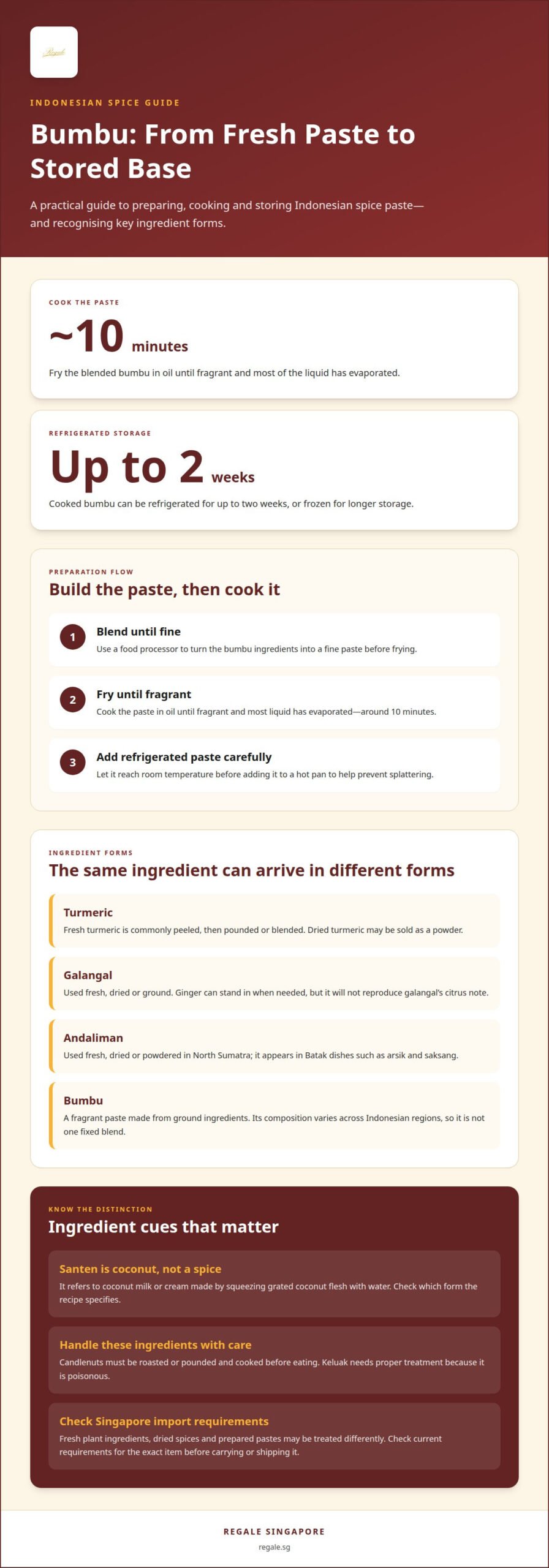
When choosing a substitute, match the ingredient’s cooking role and flavour rather than reaching for a generic seasoning. Ginger can stand in for galangal when needed, though it won’t reproduce galangal’s citrus note. Chinese five-spice is not a direct substitute for bumbu, a fresh paste that can include turmeric, shallots, garlic and lemongrass.
Whether Indonesian spices can be brought into Singapore depends on the product and applicable import requirements. Fresh plant ingredients, dried spices and prepared pastes may be treated differently, so check current Singapore requirements for the exact item before carrying or shipping it.
Fresh turmeric is commonly peeled, then pounded or blended; dried turmeric may be sold as a powder. Galangal is used fresh, dried or ground, while andaliman is used fresh, dried or powdered in North Sumatra. Bumbu is a fragrant paste whose composition varies across Indonesian regions.
For preparation, a food processor can turn bumbu ingredients into a fine paste before frying. Cook the paste in oil until fragrant and most liquid evaporates, around 10 minutes. Let refrigerated paste reach room temperature before adding it to a hot pan to help prevent splattering. Cooked bumbu can be refrigerated for up to two weeks or frozen for longer storage.
Health claims require care: turmeric and cloves appear in traditional Indonesian medicine, but these uses don’t establish medical benefits. Candlenuts must be roasted or pounded and cooked before eating, while keluak needs proper treatment because it is poisonous.
Understanding Indonesian spices and their uses also means interpreting ingredient names in context. Santen, for example, refers to coconut milk or cream made by squeezing grated coconut flesh with water. The term distinguishes this coconut ingredient from a spice powder or seasoning paste.
To experience how Indonesian seasonings come together in prepared dishes, explore authentic Indonesian cuisine.
Coconut milk is a basic ingredient in Indonesian cuisine, and most curries require coconut. Treat a reference to coconut as an ingredient cue, not a spice name, and check whether the recipe specifies coconut milk or cream before preparing it. This distinction helps avoid substituting a seasoning for a coconut ingredient.
Bumbu varies between Indonesian islands and regions, reflecting local ingredients and cultural influences. The word bumbu does not mean one fixed combination: read the accompanying ingredient names and expect the paste to follow the recipe’s particular version. This helps distinguish regional variation from a different English spice label.
Indonesian bumbu dasar paste can be made by blitzing its ingredients in a food processor until fine, then frying it in vegetable oil over medium-high heat until fragrant. This sequence keeps the preparation tied to the ingredients named for the paste, rather than treating bumbu dasar as a single powdered seasoning. Read the listed ingredients and instructions together to identify what the recipe calls for.
Shallots and other aromatics
Indonesian shallots appear in almost all Indonesian recipes, either sliced or pounded into a seasoning paste. Their preparation changes how they work: slices remain distinct in a dish, while pounded or blended shallots combine with other ingredients. This makes them a versatile starting point for regional preparations.
For a smooth aromatic base, combine shallots with ingredients such as garlic, ginger, turmeric, galangal, lemongrass and chilli. These are among the fresh ingredients ground into bumbu, the fragrant paste used in Indonesian cooking. Rather than acting as a single spice, shallots help bring the paste’s flavours together as a dish’s foundation.
For more visible texture, slice shallots before cooking them with the other ingredients. For a finer result, pound or blend them with the spices. Let the recipe’s intended texture guide you: slices keep their shape, while paste spreads through a sauce or stew. Both preparations are widely used in Indonesian recipes.
Lemongrass adds another aromatic layer. Slice the stalk, then pound or crush its base before adding it to a dish to release its fragrance. Combine it with shallots and other spices in a paste, or use it alongside them in soups and stews. Its aroma complements the sharper, savoury character of shallots.
Other ingredients contribute different notes. Ginger appears in Indonesian drinks, including hot ginger water and black coffee with ginger. Cooks often roast coriander seeds, then grind or pound them into spice pastes. Cloves bring a concentrated aroma and are used as a spice in their flower-bud form. These examples show how aromatics feature in both food and drinks.
When Indonesian shallots are unavailable, large onions can serve as an emergency substitute. The finished flavour may differ, so treat onion as a practical alternative rather than an exact match. For recipes built around a finely blended paste, chop the onion before pounding or blending it with the other ingredients.
The preparation also shapes a recipe’s character. A sliced aromatic mix leaves individual pieces noticeable, while a pounded blend distributes seasoning throughout the dish. Either way, shallots, garlic and lemongrass offer a clear starting point for understanding how Indonesian cooks layer aroma. Match their form to the recipe to preserve its intended texture and bring the aromatics together.
Torch ginger buds in Indonesian and Malaysian dishes
Indonesian spices are part of Southeast Asia’s wider culinary traditions, but regional combinations and dish names differ. Torch ginger shows this clearly: Batak cooks use its buds in arsik, while Malaysian cooks add thin slices to Penang asam laksa.
Torch ginger is Etlingera elatior, a flowering plant whose buds are used in cooking. It is distinct from the familiar ginger root used in drinks and spice pastes. Although the names can cause confusion, the ingredient and its culinary role are different. Its buds feature in Indonesian and Malaysian dishes in several forms.
In North Sumatra, torch ginger buds appear in arsik, a Batak fish dish. This places the ingredient within a particular regional cooking tradition, rather than suggesting that every Indonesian fish dish uses it. Arsik shows how local ingredients can help define a preparation.
Torch ginger buds also feature in salads, sambals and coconut-based stews. These uses show how one ingredient can move between different dish formats. In a salad, the buds contribute as part of a fresh combination; in sambal, they join a chilli-based accompaniment; in a coconut stew, they are incorporated into a cooked preparation.
Malaysia offers a useful comparison. Cooks thinly slice torch ginger buds for Penang asam laksa. This differs from the ingredient’s place in Batak arsik, a fish dish. The shared ingredient connects regional cuisines, while each named dish gives it a distinct context.
Preparation affects how the buds appear in a recipe. Thin slices, as used in Penang asam laksa, remain visible in the finished dish. In salads and sambals, the buds are ingredients, not merely decoration. In a coconut-based stew, they become part of a cooked mixture. These examples show why preparation and recipe format matter.
For cooks exploring Southeast Asian ingredients, torch ginger is a reminder that the region is not one uniform cuisine. Indonesian cooking includes distinct regional practices, such as Batak use in arsik. Malaysian cooking has its own preparations, such as Penang asam laksa. The ingredient crosses culinary borders, but dish names and methods preserve important differences.
When reading a recipe, note both the ingredient and its preparation. “Torch ginger” identifies the bud, while “thinly sliced” describes how it is used in Penang asam laksa. In another recipe, the same buds may appear in a salad, sambal or coconut-based stew. Match the preparation to the named dish to retain its intended regional character.
Indonesian spices and ingredients belong to the wider Southeast Asian culinary tradition, with regional combinations and dishes shaping their differences. Torch ginger, for example, appears in Batak arsik and Malaysian Penang asam laksa, but in different dish contexts and preparations.
Andaliman’s flavor and Batak cuisine uses
Andaliman is a regional seasoning associated with North Sumatran Batak cooking. Its name identifies a specific species, Zanthoxylum acanthopodium, and its culinary context is especially clear in arsik and saksang. These dishes show how a local ingredient can help define a regional food tradition.
Andaliman is best understood through its use in Batak dishes, rather than as a general substitute for pepper. It contributes to the seasoning of preparations such as arsik, a North Sumatran fish dish, and saksang. These dish names give cooks and diners a practical reference for where andaliman belongs.
Andaliman is not interchangeable with every spice that adds pungency or aroma. Indonesian recipes combine ingredients in region-specific ways, and andaliman’s role comes through the dishes it seasons. In Batak cooking, arsik and saksang are two clear examples. This distinguishes a regional seasoning from spices used more broadly across Indonesian cooking.
In North Sumatra, andaliman is used fresh, dried or ground into powder. Each form offers a different way to use it in cooking: fresh andaliman remains whole, while dried and powdered versions are processed. The recipe and desired texture help determine which form suits the preparation.
For arsik, choosing fresh, dried or powdered andaliman affects how the seasoning is handled. Whole forms remain identifiable before preparation, while powder can be blended directly with other seasonings. These are differences in form, not separate species. Andaliman’s identity remains tied to its Batak culinary use.
Saksang offers another reference for understanding andaliman’s regional role. Alongside arsik, it shows that the ingredient appears in more than one named Batak preparation. Rather than assuming it belongs in every Indonesian curry, soup or rice dish, connect it with the dishes in which it is used. This keeps regional food traditions clear.
When reading recipes, note whether andaliman is fresh, dried or powdered, then consider how that form suits the dish’s preparation. A recipe naming arsik or saksang signals its regional context more clearly than a generic label such as “spiced dish.” The species name, Zanthoxylum acanthopodium, can also distinguish andaliman from other ingredients called pepper.
To enjoy Indonesian cooking through prepared dishes, explore authentic Indonesian cuisine and experience the regional traditions behind its flavours.
Galangal is used as a flavouring or spice in Indonesian cuisine and adds a citrus note to dishes. Santen is made by squeezing grated coconut flesh mixed with water, producing a liquid used as coconut milk or cream. Cardamom pods sometimes flavour Indonesian soups, stews, desserts and drinks.
Coriander, nutmeg and cloves are among the native spices that continue to define Indonesian food. Indonesian cinnamon is milder and sweeter than other types of cinnamon. Saffron is rare, expensive and not commonly used in Indonesian cuisine.
Regale Singapore
Regale Singapore offers a way to enjoy Indonesian cuisine as prepared dishes, after exploring the ingredients and regional traditions behind it. Its offerings include Authentic Indonesian Cuisine, Nasi Sambal Goreng and Nasi Ambeng, alongside Western Cuisine. This provides a practical next step for readers who want to experience Indonesian cooking rather than only learn ingredient names. The dishes offer an opportunity to appreciate how a complete meal brings together flavours and culinary traditions. Choose this dining experience when you’re ready to explore Indonesian food in Singapore. For a different preference, Western Cuisine is also available. To discuss dining at Regale Singapore, contact the team.
Bring Indonesian Flavours to Your Next Meal
Understanding Indonesian spices and their uses can make unfamiliar dishes easier to appreciate, but tasting them brings another dimension. Let the ingredients guide your next meal: notice how seasonings, aromatics and regional traditions come together in a prepared dish, then follow the flavours that interest you.
Regale Singapore serves Indonesian cuisine, including Nasi Sambal Goreng and Nasi Ambeng, at Regale at Science Centre. These dishes offer a welcoming way to continue exploring Indonesian food, whether you’re choosing a familiar favourite or discovering something new.
Contact Regale Singapore today to plan your next dining experience. Take what you’ve learned about Indonesian ingredients into your next meal, and enjoy discovering the cuisine at your own pace.
Frequently Asked Questions
What are the most commonly used Indonesian spices?
Common Indonesian spices include coriander, cumin, turmeric and lemongrass. Other familiar seasonings include nutmeg, cloves and Indonesian bay leaves. Their roles differ: bay leaves are used whole to add depth, while nutmeg appears in soups, stews and curries. Pandan leaves fragrance cakes and desserts, while palm sugar sweetens many Indonesian desserts.
What are Indonesian spices used for in traditional dishes?
Indonesian spices season dishes, build fragrance and contribute distinctive regional character. Beyond curry and spice pastes, banana leaves wrap rice or meat into parcels for grilling or steaming. Indonesian bay leaves add depth to cooked dishes, while pandan perfumes cakes and desserts. Sambals, Indonesia’s chilli sauces, accompany meals as a lively seasoning alongside other foods.
What are the differences between Indonesian spices and Southeast Asian spices?
Indonesian spices are part of Southeast Asia’s wider culinary traditions, but combinations and dish names vary by region. Torch ginger, for example, appears in both Indonesian and Malaysian dishes, prepared in different ways.
What health benefits and risks are associated with Indonesian spices?
Turmeric and cloves are used in traditional Indonesian medicine, but those uses do not establish medical benefits. Candlenuts must be roasted or cooked before eating, and keluak needs proper treatment because it is poisonous.
