

The safest buffet plan starts with a portion estimate, not a guess: serving sizes for buffet catering in Singapore can begin at 300-400 g of cooked food per adult for a standard buffet, plus a 10% food buffer. For a full dinner, plan around 380-400 g per guest. The right amount also depends on the menu, event length and guest mix.
It makes sense to plan for seconds, but ordering the maximum amount of every dish can leave you with too much food. A balanced estimate considers how much rice or other staples, protein, vegetables, sides and dessert guests are likely to take, then adjusts for the occasion. This guide explains how to calculate portions, adapt quantities for different events and account for menu variety and serving style, so you can plan a generous buffet without over-ordering.
Key Takeaways
- Build your estimate around the event format and guest mix, then divide food across staples, protein, vegetables, sides and dessert.
- For events lasting several hours, plan how food will be replenished; short gatherings can use standard portions.
- Adjust dish count to the guest list so the menu offers variety without making every item a full-sized portion.
- Allow for about 1.25 main-dish servings per guest, and distribute portions across the protein options on the menu.
- Use the event’s timing and guest profile to refine quantities and reduce the chance of running short or ordering too much.
1. How Do You Calculate Food Portions for Catering?
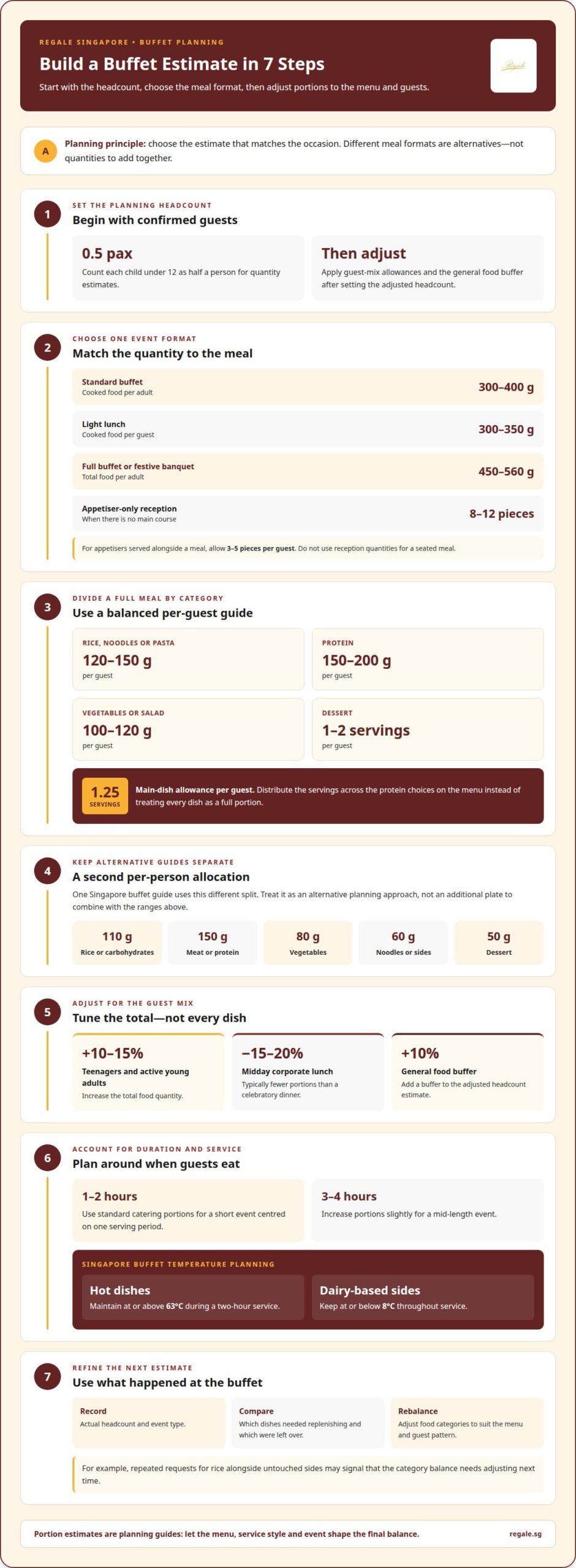
Start with the event format, then estimate each food category separately. For a full meal, a useful planning range is 120g to 150g of rice, noodles or pasta per guest. Pair this with 150g to 200g of protein, 100g to 120g of vegetables or salad, and 1 to 2 dessert servings. Treat these as planning estimates, not amounts to add indiscriminately: the menu and service style determine how the portions fit together.
For a Singapore light lunch, plan 300-350 g of cooked food per guest. An afternoon tea can offer around 5 to 7 items across savouries, staples and desserts. For an appetiser-only reception without a main course, allow 8 to 12 bite-sized pieces per person. When appetisers accompany a meal, reduce that to 3 to 5 pieces per guest. The occasion changes the estimate, so don’t use reception quantities for a seated meal.
Use category estimates to check the overall balance. One Singapore buffet guide allocates 110 g of rice or carbohydrates, 150 g of meat or protein, 80 g of vegetables, 60 g of noodles or sides, and 50 g of desserts per guest. Another full-meal guide uses broader ranges, including 100g to 120g of vegetables. These are different planning approaches, not amounts that should automatically be combined into one plate.
- Staples: Plan 1 cup cooked rice or grains, approximately 5 ounces, per person. For side-dish pasta, allow 4 ounces uncooked per person, yielding about 1 cup cooked.
- Vegetables: Allow 4-6 ounces of cooked vegetables per person. For raw vegetables, such as salad or crudité, plan 1 cup, about 5 ounces.
- Other sides: Cooked potatoes call for about 6 ounces per person. For buffet catering, plan about 3 ounces of leafy salad per guest.
Plated meals need a different check because guests receive set portions rather than choosing from shared dishes. A plated meal guide suggests 6-8 ounces of protein per person, compared with 5-6 ounces for buffet catering. Check the plated menu as a complete serving, including its protein, staple and vegetables, rather than treating each buffet option as a separate full portion.
Review feedback against what happened at the event. Compare the portion estimates with which dishes needed replenishing and which were left over. For example, repeated requests for rice alongside untouched sides may indicate that you should adjust the balance of food categories next time. These observations help make future serving sizes for buffet catering more accurate for the menu and guests.
2. How Much Food Should You Order for Different Events?
Begin with the confirmed headcount, then match the total food estimate to the event. For a standard Singapore buffet, plan 300-400 g of cooked food per adult. A full buffet or festive banquet may call for around 450g to 560g per adult for the entire meal. These estimates describe different meal formats, so choose the one that fits the event rather than adding both together.
Lunch and dinner do not always call for identical quantities. A midday corporate lunch typically requires 15-20% fewer food portions than a celebratory dinner. For cocktail receptions, use the appetiser-only estimate of 8 to 12 bite-sized pieces per person when there is no main course. The menu’s role matters: substantial dishes and a full meal make a reception estimate unsuitable.
To avoid shortages, build a buffer into the confirmed headcount instead of increasing every dish separately. Buffet organisers in Singapore are advised to add a 10% food buffer. For teenagers and active young adults, increase the total food quantity by 10-15%. Children under 12 should be counted as 0.5 pax when estimating quantities. These adjustments account for guest mix without treating every child or adult as needing the same amount.
For example, apply the child allowance before adding the general buffer. If the guest list includes adults and children under 12, first convert the children into the equivalent planning headcount. Then apply the buffer to that adjusted total. This order keeps the allowance transparent and reduces the chance of counting children as full adult portions, then adding extra food without a clear reason.
Singapore buffet food safety planning includes temperature control during service. Hot buffet dishes should be maintained at or above 63°C during a two-hour service; dairy-based sides should be kept at or below 8°C throughout service. For leftovers, distinguish untouched reserve food from dishes already placed on the buffet, and base handling decisions on how each item was held. This helps prevent leftover estimates from being mistaken for food that remained protected.
After the event, record which dishes ran low and which remained, together with the actual headcount and event type. A full dinner for a larger youth group may call for a different adjustment from a midday corporate lunch. Use these observations to refine future serving sizes for buffet catering, while keeping the core estimate tied to the menu and occasion.
For a menu planned around halal dining, explore halal buffet catering as a suitable option for your gathering.
3. Event duration and food quantities
Event duration affects how guests approach a buffet. A short gathering may have one clear meal period, while a longer programme can bring changing appetites and return visits. Match the meal plan to the schedule: note when guests arrive, when the main meal begins and whether food remains available throughout. A reception followed by dinner needs a different serving plan from an event built around one meal.
For short events lasting 1-2 hours, use standard catering portions. The compact schedule usually centres food around one serving period, so plan the spread to suit that meal rather than adding separate rounds. For example, a brief lunchtime meeting can focus on the lunch service instead of assuming guests need food before and after it.
For mid-length events lasting 3-4 hours, increase portions slightly. Guests have more time to return to the buffet, especially if the meal begins early in the programme. For a dinner that runs across several hours, think about how long the main dishes need to remain available. A generous initial setup matters, but the timing of replenishment also affects what guests find later.
Long sessions and full-day events call for multiple rounds of food. Rather than putting every dish out at the start, align each round with a meal or break in the schedule. A morning programme followed by an afternoon session, for example, may need separate food breaks. This spreads the food across the event instead of treating a full day like one continuous meal.
- Short event: Keep the plan centred on one serving period and standard portions for 1-2 hours.
- Mid-length event: Increase portions slightly for a 3-4-hour programme, and plan how the buffet will serve guests later in the event.
- Long session: Schedule multiple food rounds around meal periods or breaks, rather than relying on one setup.
Hors d’oeuvres depend on whether a full meal follows. Before a full meal, provide 4-6 pieces per person. These starters should bridge guests to dinner, not replace the main meal. For a reception that transitions into a buffet, set the starter quantity with the meal timing in mind. Guests arriving well before dinner may eat differently from those arriving close to the main service.
Use the event agenda as a planning tool. Mark the meal, breaks and programme end, then decide when each round of food should be available. At events lasting several hours, guests may return for more buffet servings. Replenishment timing matters: a spread that is ample at opening can feel depleted later if food service continues for a long time.
For every format, link the food plan to the actual schedule. A 1-2-hour gathering, a 3-4-hour programme and a full-day event each call for different service timing. Aligning portions and food rounds with those durations helps keep the buffet useful throughout the event.
4. Adjusting quantities for menu variety
Menu variety changes how guests fill their plates. With ten or more dishes, individual servings can be smaller because guests sample more choices. A spread with four or five items works differently: guests are likely to take larger servings of each. Set quantities for the menu as a whole, rather than multiplying a full portion by every dish.
Start by matching dish count to the headcount. A Singapore buffet menu can use about one dish for every 8-10 guests as a planning guide. For a full buffet serving 50-80 guests, plan 8-10 dishes; for 80-150 guests, plan 10-12. At 150-300 guests, the guide recommends 12-15 dishes. These ranges help shape variety, but each dish still needs a role.
Group menu items by function before estimating portions. Identify the staples, protein mains, vegetables, sides and desserts, then check whether the selection is balanced. A menu with several similar starches may need less of each than one with a single staple. Mini buffet menus can also balance proteins, carbohydrates, vegetables and desserts while limiting excess of any one dish.
Dietary needs and appetite differences call for deliberate allocation. For a Singapore buffet plan, allow a 20-30% vegetarian split. This gives vegetarian guests a meaningful share of the menu instead of leaving them with only side dishes. Teenagers and active young adults may need larger servings, so reflect their presence in the overall estimate rather than enlarging every item equally.
For children under 12, the event estimate uses 0.5 pax per child. This gives the headcount a more realistic basis than counting each child as a full adult portion. Then consider the menu itself: smaller children may take less of a spicy dish, while older children may choose familiar staples. The age mix and available alternatives shape the adjustment.
Use this practical sequence to keep menu variety from leading to excess:
- Sort the dishes: Mark each as a staple, protein, vegetable, side or dessert.
- Check overlap: Reduce duplication where several dishes fill the same role.
- Allocate alternatives: Give vegetarian choices enough quantity to serve the planned share.
- Scale portions: Use smaller servings across a menu of ten or more dishes.
For example, a 50-80-guest buffet with 8-10 dishes can offer several categories without treating every dish as a full meal. A narrower four- or five-item menu needs larger portions per choice. The number of dishes, category balance and guest mix should work together; a minute adjustment to one dish cannot correct an unbalanced menu.
5. Buffet main-dish serving allowance
Plan the main dishes as a shared category, not as a full serving of every option per guest. A buffet guide recommends 1.25 main-dish servings per person to account for guests choosing different dishes or returning for another helping. This is a planning allowance across the mains. It does not mean serving 1.25 portions of each protein to every guest.
For a well-rounded Singapore buffet, include 2-3 protein mains. With two proteins, plan 3-4 ounces of each protein per person. This gives guests a choice while spreading demand across the main dishes. If the menu offers more than two proteins, divide the expected total between them rather than multiplying the allowance by every option.
A single-protein menu needs a different quantity check. For 50 guests, a single-protein main requires roughly 8-10 kg of meat. That estimate gives the main dish a clear role in the menu. Compare it with the number of other substantial dishes: several filling mains change how much guests take from any one protein.
Rice-based dishes can also contribute substantially to the meal. In a buffet setting, 1 kg of biryani typically serves four to five guests. Use that serving estimate when biryani is a main or a major staple, then account for the other mains and sides. Treating it as an additional full meal alongside every other dish can lead to unnecessary excess.
Vegetarian planning should be part of the main-dish allocation, not an afterthought. For a 10 kg non-vegetarian main protein, one guide recommends 3 kg of paneer as a vegetarian counterpart. This example shows how a vegetarian main can be scaled alongside a meat dish. The right balance depends on the guest mix and how many other vegetarian options are available.
To turn these allowances into an order, work through the menu in sequence:
- Count the mains: Identify how many protein options will anchor the meal.
- Set the shared allowance: Use 1.25 main-dish servings per person across the buffet mains.
- Divide by choice: Allocate quantities across proteins, accounting for the menu’s other filling dishes.
- Include vegetarian portions: Provide a substantial alternative that works as a main, not only as a side.
For example, a 50-guest buffet with two proteins can use the 3-4-ounce-per-protein-per-person guide, while a single-protein menu can use the 8-10 kg estimate. These are alternative planning approaches, not quantities to stack automatically. Choose the one that matches the menu structure and the role of each dish.
For a gathering centred on a halal menu, choose a halal buffet with main dishes planned around your guest mix.
Regale Singapore: Halal Catering
Regale Singapore offers halal catering for hosts planning a buffet around their guest count and menu preferences. Its menu includes Nasi Sambal Goreng, Nasi Ambeng, authentic Indonesian cuisine and Western cuisine, giving you distinct options to consider when balancing mains, staples and sides. Choose a menu style suited to the occasion, then use your headcount and event format to guide portion planning. For gatherings where a shared spread fits the experience, Regale Singapore’s halal buffet and halal mini buffet are natural options. Contact Regale Singapore to discuss your catering needs.
Plan a Buffet That Fits Your Occasion
Turn your estimate into a concise event brief. Set out the expected headcount, event schedule, menu preferences and dietary needs in one place. This gives the food plan a practical foundation and keeps decisions about dishes and portions connected to the occasion. If the guest list changes, revisit the estimate instead of adjusting each dish without considering the full menu.
Use serving sizes for buffet catering as a planning framework, then shape the final menu around how guests will gather and eat. A family celebration, workplace lunch and evening reception each create a different dining rhythm. Clear priorities make it easier to choose a considered spread, from the first serving through to the end of the event.
For a halal menu rooted in Indonesian flavours, explore Regale Singapore catering as you plan your gathering. Take the next step with a menu direction that suits your occasion, and make space for a welcoming meal shared together.
Frequently Asked Questions
How Do You Calculate Food Portions for Catering?
Calculate portions by setting the event format and expected headcount first, then dividing the menu into food categories. Estimate staples, protein, vegetables, sides and dessert separately, so a generous amount in one category does not hide a shortage elsewhere. For example, if the menu has two substantial mains, divide the main-dish allowance between them rather than counting a full main serving for every guest from each dish.
How Much Food Should You Order for Different Events?
Choose the estimate that matches the event meal. A standard buffet in Singapore calls for 300-400 g of cooked food per adult, while a full buffet or festive banquet may need around 450g to 560g for the entire meal. A short work lunch and a celebratory dinner may not need identical quantities. Consider the schedule, menu, guest mix and likelihood of guests returning for seconds.
What is a standard buffet catering serving size per person in Singapore?
A practical standard estimate is 300-400 g of cooked food per adult in Singapore. Treat this as a total meal-planning range, not the serving weight for every dish on the table. The actual split depends on how many mains and sides are offered, whether the buffet includes dessert, and whether the occasion is lunch or dinner. A fuller banquet may require a higher overall allowance.
How many grams of food per person should a buffet provide?
For a standard buffet, plan 300-400 g of cooked food per adult. For a full buffet or festive banquet, use around 450g to 560g per adult for the entire meal. These are alternative estimates for different meal formats. Avoid adding both ranges together. If the spread contains many dishes, guests divide their plates across more choices, which changes the amount needed from each individual dish.
How much rice, noodles, or other carbohydrates should be catered per person?
For a full meal, plan 120g to 150g of rice, noodles or pasta per guest. A Singapore buffet portion guide also allocates 110 g of rice or carbohydrates per guest. Choose one approach that suits the menu rather than combining the figures. A buffet with several substantial mains may need a different staple balance from one where rice or noodles anchor the meal.
How many pieces of finger food should be provided per guest?
For a reception with no main course, allow 8 to 12 bite-sized pieces per person. If finger food comes before or alongside a full meal, plan 3 to 5 pieces per guest instead. The distinction matters: reception pieces may need to carry the food service, while meal-time appetisers are a smaller part of the overall menu. Match the quantity to the role they play.
How much meat, seafood, and vegetarian food should a buffet include per person?
For a full meal, plan 150g to 200g of protein per guest, or use a buffet guide’s 5-6 ounces per person. When serving two proteins, plan 3-4 ounces of each protein per person. Include vegetarian mains as part of the meal’s protein allocation. A vegetarian split of 20-30% is one planning baseline, adjusted to the guest mix and menu choices.
How much extra food should caterers order to avoid running out?
A 10% food buffer is a practical starting point for Singapore buffet events. Apply it to the estimated total after accounting for the headcount and menu, rather than increasing every dish without distinction. Give particular attention to popular mains and staples. Guest age mix, event timing and length can also affect demand, so use the buffer alongside those factors instead of treating it as a substitute for portion planning.
