


A corporate lunch can disrupt the workday if the meal format and timing don’t fit the team. Learning how to plan a corporate lunch event means looking beyond the menu: guest count, dietary needs, service style and schedule all shape how smoothly lunch runs. A buffet may suit a team gathering, while a mini buffet can be a practical fit for a more compact workplace meal.
It’s easy to feel unsure about portions, inclusive choices and coordinating service around meetings. A clear plan makes these decisions easier and helps keep lunch welcoming without adding unnecessary complexity. This guide takes you through the key steps, from assigning responsibilities and setting deadlines to choosing a format, collecting dietary requirements and planning service. It also looks at how halal catering and Malay and Indonesian specialities, including sharing-style Nasi Ambeng, can bring character to a workplace meal. The aim is a well-organised lunch that suits your guests and keeps the working day on track.
Key Takeaways
- Start with the lunch’s purpose and workday schedule, then set the guest list, date, format and menu in sequence.
- Collect dietary needs early and share them clearly so the menu and serving approach can welcome the whole team.
- Compare buffet, mini buffet and restaurant dining by setup space, guest movement, serving flow and organiser workload.
- To understand how to plan a corporate lunch event, work backwards from the event date and align RSVP deadlines, headcount and logistics.
- Prepare a concise catering brief with the purpose, date, guest count, dietary needs, meal format and schedule.
How to Plan a Corporate Lunch Event Around a Clear Purpose
Decide what the lunch needs to achieve before choosing dishes or a service format. A team appreciation lunch may call for a relaxed, sociable feel. Client hosting may need a more considered agenda. Onboarding can help new colleagues connect, while a milestone lunch can give recognition a meaningful place in the workday. The purpose guides the tone, timing and practical decisions that follow.
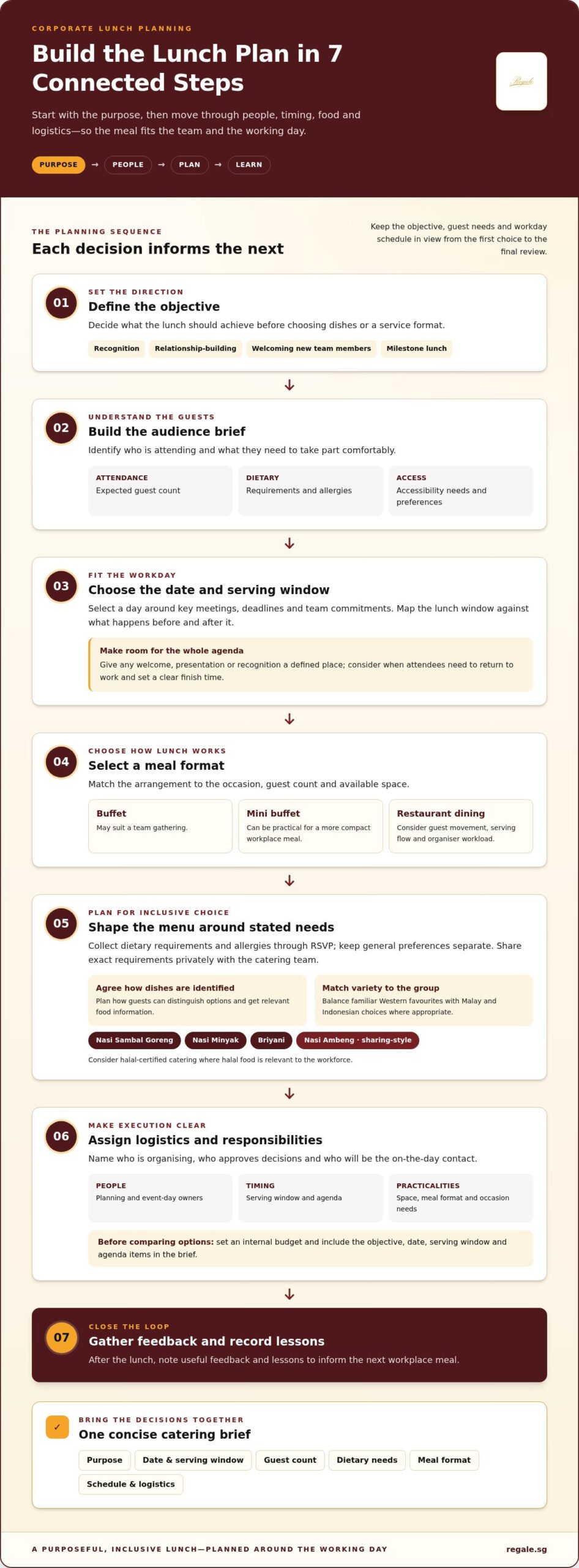
A successful corporate lunch is purposeful, inclusive and planned around the working-day schedule. The broad principles of event management also apply to a workplace meal: plan the objective, people, logistics and execution as one connected experience. Use this sequence to keep decisions in order:
- Objective: Define the outcome, such as recognition, relationship-building or welcoming new team members.
- Audience: Identify who is attending and what they need to take part comfortably.
- Date: Select a day that works around key meetings, deadlines and team commitments.
- Format: Choose a meal arrangement that suits the occasion, guest count and available space.
- Menu: Match dishes and serving style to the audience and event tone.
- Logistics: Assign planning and event-day responsibilities, then set out the timing and practical requirements.
- Follow-up: Gather feedback and record useful lessons for the next workplace lunch.
Set the objective, date, and working-day boundaries
First, decide how formal the occasion should feel. A team connection lunch may leave more room for conversation, while a client-facing meal may include a welcome or short presentation. Choose a date and serving window that fit around the team’s work, rather than expecting the agenda to bend around an unsuitable meal time.
Map the lunch window against the events before and after it. If remarks, presentations or recognition are part of the plan, give them a defined place so they don’t compete with serving and conversation. Consider when attendees need to return to work, too. A compact agenda and clear finish time help people participate without uncertainty.
Build a guest brief before choosing the meal
Prepare one planning brief with expected attendance, dietary requirements, accessibility needs and relevant preferences. These details shape both the meal format and menu decisions. Record who is organising the lunch, who approves decisions and who will be the on-the-day contact, so responsibilities don’t fall between people.
Set an internal budget before comparing menu options, and account for the practical needs of the occasion alongside food. Include the objective, date, serving window and any agenda items in the brief. With these essentials gathered, you can assess meal choices against the actual event rather than selecting food in isolation.
That is how to plan a corporate lunch event with a clear foundation: define the purpose, respect the working-day boundaries and give the organiser and attendees a shared plan to follow.
How to Choose a Corporate Lunch Menu That Includes Everyone
A thoughtful menu starts with the guest brief, not a guess about what the team will enjoy. Attendance, dietary requirements and the event’s tone help determine how much variety to offer, whether shared or individual serving makes sense, and what information the catering team needs. Plan an inclusive menu around guests’ stated needs rather than assumptions.
For organisers learning how to plan a corporate lunch event, separate dietary requirements from general preferences. Someone may avoid an ingredient for an allergy or religious reason, while another may simply prefer a different dish. These details call for different planning conversations. A clear brief helps you make considered choices without trying to accommodate everyone through guesswork.
Collect dietary requirements and communicate them clearly
Add a simple RSVP field for dietary requirements and allergies, with an optional field for general preferences. Ask guests to describe relevant needs clearly rather than selecting only from broad labels. Keep responses private and share the information with the catering team in a concise menu brief. This gives the team useful context for planning.
Before the event, agree how dishes will be identified and how the serving arrangement will help guests distinguish options. Don’t assume a dish name alone answers questions about ingredients or suitability. Give the catering team the exact requirements received, then communicate agreed food information to attendees in advance.
Balance familiar choices with distinctive menu options
A varied menu can pair familiar Western favourites with Malay and Indonesian dishes, giving guests meaningful choice without expecting one cuisine to suit everyone. Nasi Sambal Goreng, Nasi Minyak and Briyani can bring distinctive flavours to a workplace meal. Nasi Ambeng offers a sharing-style option when communal dining fits the occasion. Describe it as a format, not as a fixed set of dishes.
Consider how the group will eat as well as what it will eat. A shared meal may encourage conversation, while clearly differentiated choices can make it easier for guests to select what suits them. Match variety to the guest brief and lunch schedule instead of adding options without a clear purpose.
Where halal food is relevant to the workforce, halal-certified catering gives organisers a clear point to consider during menu planning. Regale Singapore serves halal-certified food, with Malay and Indonesian specialities alongside Western favourites. Explore Regale Singapore’s halal catering as you shape a menu around your guests’ needs.
Before finalising the menu, check that the brief distinguishes confirmed dietary needs from preferences, explains how guests will receive clear food information, and reflects the planned serving style. This review gives the catering team practical direction and helps make the meal more welcoming.
Corporate Lunch Catering Formats Compared: Buffet, Mini Buffet, or Restaurant
The right meal format depends on more than guest count. Room layout, the lunch window, event formality and how much coordination the organiser can manage all affect the fit. A buffet can encourage guests to choose and mingle, a mini buffet can suit a more compact meal arrangement, and restaurant dining can provide a hosted sit-down experience away from the usual workplace setup. None is best for every team.
Use this comparison to assess how each format may work in your setting. Treat footprint and serving flow as planning considerations, since the actual arrangement depends on the space and service plan.
| Decision criterion | Buffet | Mini buffet | Restaurant dining |
|---|---|---|---|
| Setup footprint | Needs room for food service and a clear route for guests. | Consider when a more compact meal setup is preferable. | Moves dining outside the workplace, so consider travel and the restaurant setting. |
| Guest movement | Guests move between their seats and the serving area. | Movement depends on how the meal is arranged and accessed. | Guests travel to and move within the dining venue. |
| Serving flow | Plan for guests to serve themselves in sequence and avoid crowding. | Plan how guests will reach and share the meal in the available space. | Dining follows the restaurant’s service arrangement. |
| Flexibility | Can suit guests who value choice, depending on menu and layout. | Can suit a workplace meal where a smaller serving footprint is useful. | Can suit a more hosted, sit-down occasion. |
| Organiser workload | Coordinate space, guest flow and the event schedule. | Plan placement, access and the meal’s timing. | Coordinate attendance, travel and timing with the workday. |
When a buffet suits a corporate lunch
A buffet may work well when the room has enough space for a serving area and guests have time to move through it. Before choosing this format, map the route from seats to food and consider whether queues could interrupt a presentation or shorten the meal. Allow clear access for guests and fit the serving period around the agenda. Agree which arrangements cover staffing, equipment, setup and cleanup.
When a mini buffet or restaurant meal may fit better
A mini buffet is worth considering when the workplace has limited space or the organisers prefer a more compact meal setup. Restaurant dining may suit a client-facing occasion or a hosted lunch where leaving the office fits the schedule. Weigh travel, interaction, formality and coordination together. Regale offers halal buffet and halal mini buffet options for workplace catering, with the format guided by your event’s practical needs.
As you decide how to plan a corporate lunch event, compare each format against the actual room, attendance and available lunch time. That simple check can help you choose an arrangement that supports conversation and keeps the workday moving.
Corporate Lunch Event Checklist: Timing, Portions, and Day-Of Logistics
A smooth lunch depends on clear ownership and a realistic run sheet. Work backwards from the time guests need to return to work, then set the RSVP deadline, final headcount, catering brief and event-day contact around that boundary. Keep the schedule practical: food arrival, room access, serving, remarks and agreed cleanup arrangements all need a place in the plan.
Share the final guest count and service timeline in one written brief. This gives organisers and the catering team a common reference and reduces last-minute misunderstandings. Distinguish responsibilities the workplace will handle from service tasks agreed with the caterer.
Set a realistic lunch timeline and responsibilities
Give each coordination task an owner. One person can manage RSVPs and dietary information, while another handles room access or internal approvals. Name a single event-day contact for catering coordination and include their details in the run sheet. Work backwards from the return-to-work time so remarks, serving and the meal itself fit within the available window.
Use a simple checklist in sequence:
- Before the RSVP deadline: Share the attendance request and collect dietary information.
- After responses close: Review attendance and send the latest confirmed headcount.
- Before the event: Share the menu brief, timing, room details and event-day contact in writing.
- On the day: Follow the run sheet for arrival, setup responsibilities, serving, remarks and agreed cleanup tasks.
Record a responsible person and contact detail beside each milestone. That makes it easier to resolve a delay or schedule change without leaving colleagues unsure who is coordinating the next step.
Confirm attendance, portions, and the room setup
Use the latest confirmed attendance to guide portion planning. The right quantity depends not only on headcount, but also on when lunch is served, the menu composition and how long the event runs. A meal served after a long morning may call for different planning from a shorter lunch between meetings. Share these details with the catering team rather than estimating portions from the invite list alone.
Walk through the room plan in advance. Check table space, serving areas, access routes and where rubbish should go, along with any workplace rules that affect food service or room use. Consider how guests will move through the space and whether chairs, presentation equipment or meeting-room layouts could obstruct access. Agree which setup and cleanup tasks belong to the workplace and which are part of the service arrangement.
Plan for likely changes. Decide who will communicate an attendance update, who can adjust the run sheet if a meeting overruns, and what alternative arrangement could work if the planned serving area is unavailable. Review the written brief and day-of contact details before the event, particularly if the schedule or room has changed.
For a workplace meal supported by halal buffet or mini buffet catering, plan your corporate lunch catering with Regale around the confirmed headcount, schedule and room requirements.
Bring Your Corporate Lunch Plan Together with Regale’s Halal Catering
A well-prepared decision brief makes it easier to turn your lunch plans into a practical catering enquiry. Bring together the event purpose, date, confirmed headcount, dietary needs, preferred format and serving schedule. Add workplace details that could affect how guests access or enjoy the meal, such as room layout or a short presentation during lunch.
This is where planning becomes specific. Instead of choosing food in isolation, match the menu and service format to the team, the space and the time available. Regale offers halal catering, halal buffet and halal mini buffet options, with Malay and Indonesian specialities alongside Western favourites.
Match Regale’s halal menu and service options to the brief
For a team with varied tastes, familiar Western favourites can sit alongside distinctive dishes such as Nasi Sambal Goreng, Nasi Minyak or Briyani. Nasi Ambeng is a sharing-style option when a communal meal suits the occasion. Use the guest brief to guide your choices, and communicate dietary needs clearly as part of the menu discussion.
Then consider the room and serving flow. A halal buffet may suit a gathering with space for guests to move between tables and food, while a halal mini buffet may be a better fit when a compact setup suits the workplace. The right choice depends on the event’s formality, layout and schedule. Keep the brief focused on your preferred format and the practical requirements that will shape the meal.
Prepare the details for a straightforward catering enquiry
Before making an enquiry, gather the information that will help describe the event clearly:
- Purpose and date: Note the occasion and when the lunch will take place.
- Attendance: Share the latest expected or confirmed guest count.
- Dietary needs: List requirements and allergies separately from general preferences.
- Meal format: Indicate whether a buffet or mini buffet best fits the event plan.
- Serving window: State when lunch should take place and when guests need to return to work.
- Workplace setup: Describe relevant room, access and serving-area constraints.
Keep these details together in one brief, so the event’s needs are easy to understand and discuss. If attendance or timing changes, update the brief rather than relying on separate messages or outdated figures. A clear summary also helps you compare your intended meal format with the realities of the workplace.
With the objective, guest details and schedule in hand, you have a practical foundation for how to plan a corporate lunch event. Explore Regale’s halal catering, buffet and mini buffet options to shape a workplace meal around your team and event.
Make Your Next Corporate Lunch Easier to Deliver
Before the event, decide what success will look like beyond a meal served on time. It might be a chance for colleagues to connect, a warm welcome for new team members or a client gathering that feels considered. After lunch, note what worked and what you’d adjust. Those observations can become a practical reference for future events, helping your team refine its approach without starting from scratch.
That’s a useful final step in learning how to plan a corporate lunch event: make each gathering easier to organise than the last. Keep feedback focused on the experience, including whether the format suited the occasion and the schedule felt comfortable for guests.
When you’re ready to shape the catering around your plans, explore Regale’s halal catering options for your corporate lunch. A clear brief and considered menu give your team a confident starting point. With the right preparation, your next workplace lunch can feel welcoming, purposeful and well paced.
Frequently Asked Questions
How far in advance should I plan a corporate lunch event?
Start planning as soon as you have a likely date and purpose, then allow enough time for approvals, invitations and menu decisions. The lead time depends on the guest count, workplace arrangements and how much coordination the lunch requires. For a date near a busy work period, begin earlier so you have room to resolve clashes. Set an RSVP deadline that leaves time to finalise attendance and share the meal brief.
How do I choose between a buffet and a mini buffet for an office lunch?
Choose based on the room and how guests will move through it. A buffet may fit a larger space where people can queue and serve themselves without blocking meeting areas. A mini buffet may be more practical in a compact room or where a broad serving line would interfere with workstations. Sketch the layout, including doors and access routes, before deciding. The best fit is the format guests can use comfortably within the lunch window.
What information should I collect from employees before ordering a corporate lunch?
Collect attendance, dietary requirements, allergies and any preferences that affect meal selection. You can also ask whether someone needs an access arrangement that may shape seating or food placement. Keep required dietary information separate from optional preferences, so the catering brief is easy to interpret. Ask for responses by a stated deadline and avoid collecting personal details that don’t affect the meal or event arrangements.
How can I accommodate halal and other dietary requirements at a corporate lunch?
Ask employees to state dietary needs clearly, including whether a requirement relates to religion, an allergy or a preference. Share each requirement with the catering team and request clear information about suitable dishes and how guests can identify them. For halal needs, specify that requirement directly rather than assuming a menu description is sufficient. Regale is a halal-certified culinary establishment, and organisers should communicate other dietary needs separately.
How much food should I order for a corporate lunch?
Base quantities on confirmed attendance, whether lunch is replacing a full meal, what the menu includes and how long the event runs. A brief working lunch with no other food calls for different planning from a session where refreshments are also served. Avoid relying on invitations sent or registrations alone if responses are still changing. Give the final headcount and event context to the catering team so portion planning reflects the occasion.
Can a corporate lunch fit into a short workday break?
Yes, if the meal plan is built around the break rather than an extended programme. Keep remarks brief, choose a serving arrangement that won’t create unnecessary bottlenecks, and communicate the start and finish times in advance. If employees need to collect food at different times, account for that in the schedule. A shorter lunch can still feel welcoming when guests have enough time to eat and return to work without rushing.
What should a corporate lunch event run sheet include?
Include the event start and finish, key milestones, the person responsible for each task and the event-day contact details. Note when the room will be accessible, when food is expected, when serving begins, and where any welcome or presentation fits. Add a contingency contact or decision-maker for delays and room changes. Share the final run sheet with everyone involved, and keep one current copy available on the day.
